|
|
|---|


Monday, 25 July 2011
Another week, another forgotten character to wax on about. Sometimes I think it’s not so much a character that’s forgotten as it is an actor who’s completely forgotten, so that any interesting character becomes something of collateral damage. It doesn’t help when you’re not a technically “big name” in a film where some big names are rubbing shoulders and I think that, perhaps, that’s what happens with

For the record, Kill Bill is my favourite Tarantino film – it’s an outrageous blend of disgusting gore and irreverent humour and it works, Uma Thurman is fabulous. But, my allegiances have never really been with the Bride, at least not for the first volume because I’ve always had a soft spot for Lucy Liu (who, I’ll maintain, was excellent in Charlie’s Angels). She plays O-Ren Ishii in Tarantino’s film, the first on the list. The introduction to O-Ren Ishii is my favourite of the lot. Liu is one of those actors who works well with expressions, the volume of her work here depends on emotion transferred not by words by her eyes and you don’t doubt the bio that the Bride gives her.
“At a time when I knew the least about my enemies the first name on my death list O-Ren Ishii was easiest to find but, of course, when one manages the difficult task of becoming queen of the Tokyo underworld one doesn’t keep it a secret – does it?”

The film is all about those quick moments that take you from the trite to the insaneand Liu has a sort of animalistic physicality so that imagining her as Queen of the underworld is believable even as you find it a bit comical as she moves from


in a matter of minutes.
It’s the run-up to her death that’s my favourite chapter. The Bride decapitates O-Ren’s army and, sure, it’s full of virtuoso and whatnot but it’s not the battle that gets me in that scene. It’s the part where The Bride realises that she might have underestimated her enemies. I love the banter between Uma and Lucy.

O-Ren: “You didn’t think it was going to be that easy, did you?”

The Bride: “You know, for a second there, yeah I did.”

O-Ren: “Silly rabbit...”


O-Ren/The Bride: “...Tricks are for kids.”
 It’s such a perfect moment, not only does it underscore the zaniness of Tarantino Lucy gets to be awesome – just a few moments before her death. I remember back when everyone was ruminating on a potential candidate for Catwoman I said Lucy Liu was the best choice, and I stand by that claim. She's agile, she an do pity and she fights like an animal.And, she's photogenic...which can never hurt.
Yeah, sure, O-Ren is a psycho murderess and what not, but I still feel a bit bad when she gets killed by that Hattori Hanzo sword. And, she gets a killer final line.

“That really was a Hattori Hanzo sword...”
So, sure, The Bride is an iconic character and whatnot - O-Ren Ishii is worth remembering...right?
Tuesday, 19 July 2011
Ensemble films tend to turn up when you get to thinking about forgotten characters. With casts that are as expansive as most large ensembles there is some actor who ends up getting shafted – especially when their role isn’t as pivotal to the story’s major arcs. Thus, in a way, I can understand why this particular performance isn’t remembered more often but I still have massive love for

Judy is something of an emissary in Vicky Cristina Barcelona. It’s her house that Vicky and Cristina stay at whilst in Barcelona; it’s through her – tangentially – that they meet Juan Antonio and so on. Vicky Cristina Barcelona isn’t quite classic Woody so there’s a tendency for Judy’s appearances in the film to feel a bit perfunctory at times but that’s where Patricia Clarkson comes in. She’s more than adept at acting from the side-lines and infuses Judy with some interesting tics to make her more than just a springboard for the film’s bigger issues. One of her first lines in the film is her throwaway, “It’s so nice to have a little action around here” to the girls. It sounds a bit on-the-nose considering the hijinks they’ll get in to later but I like to think of it as proof of how much of an instigator Judy likes to be. She wants the girls to get into shenanigans so she can live vicariously through them, but as early as her first scenes you get the feeling that she’s jealous of their youth. When Vicky talks of her academic future and her fiancé, Judy glibly responds,

“All her conflicts will be resolved when he makes her pregnant.”
It’s not even said bitterly, that’s just what Judy thinks of married woman – no identity.
It’s a lead up, of course, to her big scene in the beginning of the film’s third act, after Vicky witnesses her kiss with her husband’s friend Jay.

“I haven’t been in love with Mark for years.”
It’s not the most seminal of monologues, she goes through the usual concepts of an unhappy marriage, a fear of getting out of it, the moment passing but it’s not so much the lines as Patty’s expressions through out.


And that line, “I can’t leave him now, and I know I never will.”
Our final shot of Judy occurs after her misguided attempts to get Vicky to hook up with Juan Antonio. With her plans awry she settles, desolately, back into her routine – no excitement to vicariously enjoy. If that isn’t the face of a woman with a backstory, I don’t know what is.

Do you have any left over love for Patty in Vicky Cristina Barcelona, or is she lost in the shuffle?
Monday, 11 July 2011
Voila, the return of Forgotten Characters.
Who could forget Dirty Dancing? It’s got one of the most ubiquitous movie soundtrack, it beats out Ghost for Patrick Swayze’s most memorable film and it’s ingrained in pop culture in a way most films from its era could only hope for. We can all essentially agree that no one puts Baby in a corner, but Dirty Dancing has got a whole lot more going for it than the two leads. In fact, other than their dancing I find the leads a bit bland. The film’s much more rewarding when I think of it in terms of the peerless soundtrack and the roster of bit supporting players. And, as far as supporting players go in the film none make as big an impression on me as this next woman. The oft-forgotten, but more than functional

If you’re a fan of the small screen, you probably know Bishop best as the victim of countless Emmy snubs for her performance as the sometimes acerbic mother of Lorelai Gilmore on Gilmore Girls. She’s less acerbic, and more June Cleaver in Dirty Dancing. Really, the film is less than interested in her but like all those moments when good actors get terrible roles she makes it seem much more significant than it is. She gets her first line when her older daughter begins lamenting about a pair of shows she didn’t bring along. What always amuses me is how un-ironic is in her dealings with her flight daughter.

It’s as stereotypical a role as you’d expect. Baby is a daddy’s girl, so it’s Jerry Orbach Mr. Houseman who gets to be the parent in charge, but Marjorie still has her moments. Like when Jake threatens to end the vacation early preventing the family from enjoying the going-away party the lodge throws.

It’s her last scene that always gets me, though. Which is odd, considering she doesn’t do much. But, for one, she looks lovely all dressed up there. She goes all mother lion and prevents Jake from going all crazy when Bobby shows up and she gets my favourite line in the film when, whilst watching Baby on stage she leans over to her husband and goes...


She’s so much fun.
Did you have eyes for Jennifer and Patrick only, or do you remember Bishop in Dirty Dancing?
Sunday, 9 January 2011
 One of my favourite blogging traditions of this season is StinkyLulu’s supporting actress blog-a-thon. I can’t profess as unmitigated a love for the category as our venerable host, but time and time again it’s the supporting women who offer up surprising gems that, of course, go unnoticed. One of the terrible things about being deprived of sleep and overly busy, though, is missing out on events like these which meant I took some time to compile a post, or even decide on a performance to feature. My decision to choose Blanchard wasn’t rooted in a desire to go against the grain, the fact is I was mulling over the idea of Dianne Wiest in just because she’s so brilliant and then it occurred to me that the mainstay of StinkyLulu’s feature was celebrating those supporting actors forever on the sidelines – but still doing excellent work – which made Tammy Blanchard’s Izzie an obvious one to write on.
 Blanchard, probably most noted for her excellent work as Judy Garland in ABC docudrama Life With Judy Garland: Me & My Shadows, plays Kidman’s somewhat wayward younger sister. I’m still generally flummoxed at the tepid response to Rabbit Hole (my review). Sure, the critics have responded positively but the film has, thus far, made a mere $500,00 at the box-office and other than Kidman’s admittedly stellar work is being virtually ignored by every single awards’ body. David Lindsay-Abaire’s script doesn’t thrive on being especially rote, even though Izzie ostensibly exists as the ying to Becca’s Yang. She’s not really that wayward, even if her first introduction to us is after a bar fight. It’s not the fight that’s important, though, it’s watching the relationship between Becca and Izzie being set up right there.
  All through their conversation it’s not so much that she’s baiting her sister, but Izzie is already used to this and I just love the little moments where the slightest of tics enunciate that. Rabbit Hole moves along gradually and Lindsay-Abaire doesn’t come out immediately and tell us that the main duo is a grieving couple, but the clues are there and not in a thriller-esque way....but in the sort of way we’re given an idea – but not explicitly told. That moment the next morning when Becca finds out that Izzie’s pregnant works a bit like the aforementioned scene. Izzie is deliberately playing her role as the relaxed sibling, but she’s feeling out Becca’s response all along. True, the writing is of special importance, but Blanchard’s interpretation is just as engaging. “Why didn’t you tell me?” Becca asks, and you get the feeling that she really didn’t want to know which makes Blanchard’s response of “Why’d you think?” so important. It’s one of our first “clues” and I love how it rolls off her tongue – when the movie ends and we have all the pieces it’s makes sense that her response is so glib.
 Blanchard’s realisation of the role is essential to the tone which Mitchell creates. She can’t act over Nicole – this is her story – and her arc isn’t as easily definable as Wiest’s Nat. She’s a sort of observer, who just so happens to be participating and her intense eyes are an asset. In the same way that you can discern Becca constantly scoping out those around her, you can see Izzie constantly scoping out Becca. For all its deliberateness, Lindsay-Abaire’s script is notable for leaving so much room for thought and it’s as if Blanchard knows that whatever Izzie says – although ostensibly leisurely – is more than just incidental as far as Becca’s concerned. She’s immediately freaked out at the idea of having her child-to-be in her dead nephew’s clothes, and from just watching her eyes dart you know she’s thinking of a way to establish this sensitively. Moreover, it’s the single moment in the film where I realise that it’s not just Becca and Howie who’ve lost someone – Nat and Izzie have lost a relative too. Blanchard’s voice cracks ever-so-slightly as she says how weird it would be seeing her son running around in Danny’s clothes. She knows her sister well enough to know that even though she says she’s fine. When Becca leaves she glances in her direction and her expression there speaks volumes. It’s her lot as a supporting player, and perhaps that is Izzie’s lot as the daughter of a scene-stealer and the sister of a reticent control-freak. The sort of family who get into an argument at your birthday birthday, you have to watch closely to note just how annoyed she is with the situation.
Friday, 7 January 2011

 There’s that moment where Um, Alice in disguise is at the Red Queen’s lair – fine her castle – and there’s that confusion as to what her name is. Helena is just a treasure there, but it’s interesting watching Stayne’s face as he thinks he’s one-upped our Ladyship. Well, he has actually – but they haven’t realised it. It’s that sort of reactionary consistency – notice he’s always excessively glib when the Queen has her freak-outs to the point of disinterest – that manages to make Woolverton’s script not good, but better than abysmal. I hate and love that about-face moment where he tries to kill the Red Queen at the film’s end. I hate it because you sort of wish that their dysfunctional relationship could thrive, but it makes sense in a way and Glover does a good job of pulling it off. As he tells her, “It is far better to be feared than loved.” He’s just after the best meal ticket – and getting banished means he has no need for her anymore. Either way he’s a nice bit of fun in an ensemble that has some hits (Bonham Carter, Hathaway) and just as many misses (Depp, Wasikowska) and even though his seduction of Alice makes me shake my head it does spawn my favourite line of his – “I like you, Um. I like largeness.” Priceless.
 Tuesday, 4 January 2011

 Tanya is probably most noticeable by her Foxxy Cleopatra hair from the eighties, and I probably being a bit too anal when I wonder if that faux-eighties hear is redolent of the faux-African necklace she wears recalling some deeper meaning (probably just me). I love that scene, though, where that other worker comes in and Tanya is all mocking – “I thought you should have the first taste...of my pussy.” Another line-reading I’m always liable to remember, not that she’s only good with the readings, though. As Paul shifts into the lives of Jules and the children you kind of get that he and Tanya are heading nowhere. Like that first time he turns down their liaison, her face is just a little disappointed – but it doesn’t go on too long (kudos to the Jeffrey Werner’s excellent editing). And that final scene where they do part ways manages to have some semblance of profundity because we’ve actually come to care about DaCosta’s kooky sidekick. And the fact that the film is only 90 minutesa and still get that sort of a relationship with a palpably secondary character is something worthy applauding – not only Choldenko and Blumberg, but DaCosta too.
Previously Forgotten:
3:1 Cillian Murphy in Inception
Friday, 31 December 2010


Friday, 11 June 2010
Gwyneth Palthrow in The Talented Mr. Ripley


*as the post title implies, Forgotten Characters will be in recess for the next few months. Next week I’ll debut a new feature.
Did you remember Gwyneth’s subtle performance? Or were you too caught up in the main duo?
Forgotten Characters: Season 1
Blanchett in The Talented Mr. Ripley
Richardson in The Hours
Hawke in Training Day
Monroe in All About Eve
Castle in The Lion in Winter
Bean in The Lord of the Rings: The Fellowship of the Rings
Payne in Walk the Line
Forgotten Characters: Season 2
Mulligan in Pride & Prejudice
Law in The Aviator
Poehler in Mean Girls
Firth in The English Patient
Bates in Revolutionary Road
Farmiga in The Departed
Richardson in Harry Potter & the Goblet of Fire
Noni Rose in Dreamgirls
Beymer, Tamblyn et al in West Side Story
Ryan in Changeling
Friend in Pride & Prejudice
Thursday, 20 May 2010


Tuesday, 11 May 2010

Do you remember Carol Dexter of “f**k-you-and-the-horse-you-rode-in-on” fame? Or did you forget Changeling and all that comes with it?
Wednesday, 5 May 2010

 I’m a fan of Russ Tamblyn, remembering particularly his work in Peyton Place…I’m always nonplussed to the love for George Chakiris’s uninspired take on Tybalt/Bernardo when Russ’ superior take on Mercutio/Riff is forgotten. Similarly, I often wonder why Beymer isn’t remembered as Tony. Sure, he’s lip synching, but that doesn’t make his performance any worse. Take that early moment where Tamblyn and Beymer discuss the imminent batte. The chemistry between the two is strong as Riff cajoles Tony to attend that fateful dance. Sure, I’d give Tamblyn the edge – he is the stronger of the two, but Beymer’s reticent charm shouldn’t be left unnoticed. I will say, in a decade of excellent lip synchers (Kerr, Hepburn, Wood) Beymer takes the cake. I don’t know if it’s sheer luck on his part that they found a singer who’s voice is so close to his speaking voice, but it all just comes together well. The tentative romance with wood is a beauty to watch, even though I don’t see them as obvious complements to the other. Few romantic moments are as honest as the meeting on the fire escape in “Tonight”.
 The Sharks have their moments with “America”, of course it’s more female centred because a large part of the story revolves around Anita. The female Jets aren’t as lucky. Sure, they do their dancing at the dance but they rarely get a moment to shine. Still Trikonis and D'Andrea come off well with the light comedy. I like their cutting remarks at Anybodys.Trikonis’s line-reading is a favourite of mine, “An American tragedy!” she says referring to the adrogynous girl. This soon segues into “Officer Krupke”, an oft forgotten number. It’s not as eclectic as “America” but I love it just as much. The number is sold by Tamblyn who just has a knack for the physical comedy. He completely understands the irreverent leadership of Riff (as opposed to Bernardo’s iron fist), but he’s just as loyal. Riff’s (perhaps, misguided) devotion to Tony is a significant part of his character. As they said at the beginning, “birth to earth, womb to tomb”. It’s for this reason that Riff’s death makes me sad. Bernardo’s death is only one that saddens me incidentally, I know Anita will be hurt and so will Maria. But I feel no connection to Chakiris, which is perhaps, as it should be.
Friday, 23 April 2010
When you star in a glitzy musical with a stunted character and no musical number of your own is there any way for you to thrive? The natural answer is no, you end up being forgotten. But sometimes, a paradox occurs, and both happen. There are some performances that are excellent, but due to whatever mitigating factors they end up becoming forgotten - unfortunately so. That is what happened to this excellence performance:

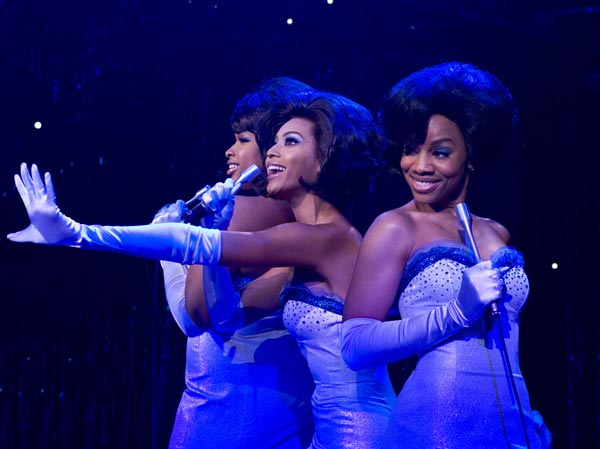
Did Anika impress you with her shrewd acting choices in Dreamgirls? Or was she rightly shafted from any love?
Previously Forgotten...
Saturday, 17 April 2010


Saturday, 10 April 2010