Showing posts with label 2006. Show all posts

Friday, 11 March 2011

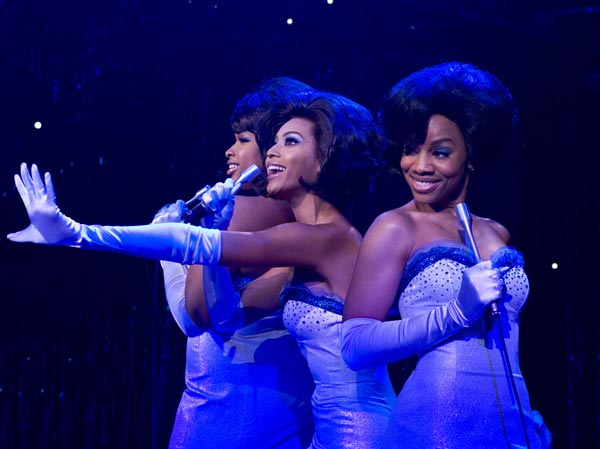
Dreamgirls and Cold Mountain have a somewhat similar history. Both were fêted as shoo-ins for Oscar Picture glory when they were in post-production, both of them racked up a slew of nominations (7 for Minghella’s piece, 8 for Condon’s) without managing to attain that elusive best picture nod. More importantly, they both won that Supporting Actress statue – performances which have gone on to be reviled in many circles. I happen to be more than a moderate fan of Cold Mountain (which I’ve reviewed before) but I’m often indecisive about where my feelings on Dreamgirls lie.* I gave it a somewhat knee-jerk B+/A- when I was doing my 2006 in review post over a year ago. I do like Dreamgirls for all its issues – of which there are many. Watching it recently, a number of things that struck me about all the times I’d seen it before resurfaced, but some even more interesting things came to mind.
I still think of Dreamgirls in context of its supporting actress, although it’s not Jennifer Hudson I turn to but Anika Noni Rose. Perspective is such a great thing, and taking Noni’s recently strong work in For Colored Girls I put even more credence in her work as Lorrell Robinson. It’s more than her age defying ability to encapsulate the youth of Lorrell (who’s half her age) – character consistency is a beautiful thing, especially in a musical like Dreamgirls which, unlike something like Moulin Rouge, takes great pains to be a slice-of-life. When Noni Rose plays opposite Murphy on that tour bus (“You’re so crazy, Jimmy”) or breaks down, almost facetiously, in a dressing room (“Nobody’s breaking me and Jimmy up”) she manages to retain that strident character consistency that’s so necessary in the drama, and that seems more than occasionally lacking in her costars.
Still, I find that this time around I have a little more commendation for the cast itself. Although I am no champion of Hudson’s performance I find it easier to praise her collective delivery – even I applaud her enthusiasm more than her execution. No amount of jaunty editing could conceal her terrible dancing, which is no judgment on her acting ability but suggests an insufficiency in the casting area. It makes Effie’s resultant firing logical, because truthfully she is something of lead-weight if she’s not in the lead-spot, musically. She gets highest praises for “And I Am Telling You” which is odd, since her passion on “I Am Changing” is so much more piercing. There are, too, rare moments where her sincerity is palpable out-of-song. An ineffectual moment like removing an ingratiating M.C’s hand from Deena’s derriere is so well played which only underscores her promise – which has yet to be realised.
On that note of unrealised promise, I turn to Beyoncé who so easily emerges as the performer most likely to be condemned. Depending on my mood I’d say Beyoncé is either just as competent in her role as Hudson, or at times even better. Watching it recently, I feel more inclined to the latter. That glassy-eyed vacant stare which marks Knowles Deena works not only in accordance with her range, but takes on greater meaning when taking the narrative into perspective. It’s that sort of vague suggestion of being vacuous that makes her Deena such a good performer – as Curtis says, she’s nothing but what he puts into her. It works better in the film’s first half, and where Knowles triumphs decisively is in her performances. It’s a surprising thing, but she manages to eschew her natural stage charisma to retain those same characteristics of her characters which makes a number like the eponymous one work because you actually believe you are watching Deena Jones – even if her spoken lines all too often retain a clunky delivery.
It’s that sort of juxtaposition of the good and the bad which marks Dreamgirls. Condon is so adamant in trying to avoid the book-numbers of the musicals, he’s so determined to ensure that the musical numbers occur in a realistic format, the times when he decides to retain pieces like “Family” or “It’s All Over” become problematic. “Family” is especially awkward because it is a number so rich with an almost cringe-worthy amount of sentimentalism. Its placement immediately before the Dreamettes debut (that is not the least bit familial) is subverted by Condon’s occasional tunnel-vision. Which makes me consider Marshall and Nine. Despite the tongue-lashing it received, Nine consistency in its musical numbers makes it a more laudable piece – cinematically, especially.

Then, of course, there’s the male ensemble. Keith Robinson C.C seems less superfluous now, if only because he’s working doubly hard to ensure that the character’s blandness don’t show much. I’m neither fond of nor hateful towards Murphy’s Jimmy. It endures as a fine comedic turn from him, no worse than the few good comedic performances he’s delivered in pieces like Coming to America or Trading Places. It’s Jamie Foxx’s exasperating Curtis Jackson who’s the film’s true albatross. He’s consistently awkward in the role contributing an unremitting impediment to any organic establishment of plot-points.
It’s a bit unfortunate, but a succinct criticism of Dreamgirls could be made from just watching the first fifteen minutes. Condon infuses the narrative with an almost – almost– nauseating amount of colour pyrotechnics culminating in production design that’s strangely officious, even for a musical. What makes it officious is that, there are some moments where Condon’s visual additions add nothing to the story. “One Night Only” ends up coming off for good and for bad, since even when you get the point of the recreation of a real music video being done Condon gets these delusions of grandeur where it’s just a bit too much.
Today, I’d probably give Dreamgirls a solid B because it does remain as a generally enjoyable experience – and its editing is especially good, taking into account its story issues; issues which are part of the actual Broadway production as much as its cinematic counterpart. Krieger’s score never emerges as iconic as it’s endured in some circles (although the new song additions are well infused with the old ones). Dreamgirls might not be one for the ages, but I suppose it is good enough at the end of the day.

*I’m not certain why, but I feel a need to beg pardon for this lengthy discourse. This was meant to be a short look back at the film; it turned into an overly lengthy dissertation. Umm, apologies?
         
Now that almost half a decade has passed, where do your thoughts rest on Dreamgirls?

Saturday, 10 July 2010

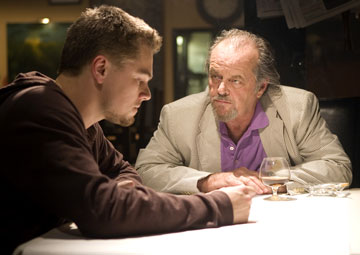
You can’t help but feel self conscious about the movies you like sometimes, and with The Departed I’m not sure if it’s me being self conscious about liking the movie (because most everyone seems to like it) or if as someone who’s quite fond of Scorsese I’m either not as fond of (or not versed in) his older work – which all the “important” people agree is his best stuff. Thus, I always feel a little uncertain when I say that The Departed is my favourite Scorsese film. It’s a weird feeling. I’m simultaneously embarrassed because it seems like a peculiar choice and yet it seems generic. It’s odd because it’s new and everyone says new films can’t be classic, and it feels generic because those unversed in Scorsese often cite The Departed as his greatest because they don’t have patience for his earlier “meandering” (their words) narratives. I mean, I have seen the essentials ones (the boxing one, the gangster one, the Christian one and the New York one) but strangely it’s the Bostonian interpretation of a Chinese adaptation that has my allegiance. But why should I worry? The internet is the place for unfounded allegiances, no?
It’s no wonder I get psyched when people praise it effusively, Heather, of Movie Mobsters; the original gangster of them all (blogging wise and otherwise-wise) approves of it:
"The Departed brings us what I’d consider another piece of movie immortality. Scorsese is known for his affinity for the gangster genre, and not since his Goodfellas has one so remarkable been made. The score and soundtrack where characters of their own, while coupled with a cinematography that was gritty and abrasive with an expected edge. Every once in awhile you take a trip to the theatre and are lucky enough to have an actual experience. This was one of those rare occasions."
And, really, if the mob approves I must be on to something.
I feel as if I’ve already reviewed The Departed…even though all I did was write extensively on DiCaprio’s Costigan. It’s weird, with The Aviator I reviewed it once, twice, and then wrote even more – just for good measure. But with The Departed it’s the opposite, I’m strangely closemouthed about it*. In praising The Departed, Scorsese’s direction skill is as much on focus as Thelma Schoomaker’s excellent editing. The woman is really a credit to her trade and oddly her work is more excellent here even more than in The Aviator where it seems more necessary. The Departed is rooted in its aggressive schizophrenia of sorts and it’s crafted as such. The thing is, even as it goes about claiming that its intent is on the thin line between the good guys and the bad guys (and who the hell are the good guys?) The Departed completes it narratives touching on everything else – and often with even more alacrity than the professed main theme. Yet, I don’t feel as if it’s shirking the issue either. Is Madolyn’s question to Collin “If they don’t do their jobs (i.e. criminals) you don’t have one.” a serious sociological enquiry, or is it just ill placed dinner table banter? And the obvious cycle of violence is too noticeable to be incidental. Maybe I go easy on Scorsese, because I love him so; he does get a little gratuitous sometimes – but then, I end up wondering if I’m missing something. Is there a larger reason as to why Queenan’s death is so bloody? It’s the only time I’m angry at the film (okay fine, that and Costigan’s death – I can’t quit: I know) but I’m acutely aware that his death is necessary. It’s almost like Shakespeare’s penchant for killing the innocent first (Ophelia, Cordelia, Desdemona, Banquo) but Sheen’s so good I’m just annoyed he doesn’t get the chance to do more.
If there’s one thing that’s become a bit of a trademark with Scorsese, regardless of his story, it’s not so much the inherent violent tension in his films but it’s the tendency to leave questions unanswered. It’s the same when I think of my favourite Scorsese pic that doesn’t make it into the actual top 100 – New York / New York. Despite its ostensibly tedious length Marty is always a little reticent in making judgements on his characters. It’s a bit similar with the people we touch on here. Marty is so careful not to make Costigan an unfailing hero – other than DiCaprio’s Amsterdam (and perhaps, him too) he’s always intent on using troubled men as the catalyst for his drama. Billy is not quite as perverse as Travis he has just the touch of nuanced badness – which is one the same level with badassery. He’s just as psychologically conflicted as Newland, Henry and yes even Christ. Call it consistency, or call it unoriginality or blame it on Monahan and make DiCaprio culpable, but it’s a running thread I admire and one that transcends to the supporting characters as well, although with a little less…ummm, subtlety. The intuitive M. Carter from M. Carter at the Movies brings up such salient points in reminding why this is such a good film…
"In the Scorsese gangster canon, GoodFellas tends to reign supreme. And yet there’s another film he’s made that’s every bit as edgy, brutal and grimly funny as that de facto classic. With its talent-heavy, all-star cast (DiCaprio and Damon hold their own against Jack Nicholson), The Departed, Scorsese’s twisty Infernal Affairs remake, is an exhilarating mix of find-the-rat stunts, mind games, gang rivalries, dirty politics, storylines that bend back on themselves and two deaths so shocking they keep smarting days, even weeks, later. And because it’s Scorsese, everything is set perfectly to a soundtrack that funnels complex emotions into songs."
I’m glad I’m not the only one smarting at those two deaths, and kudos to Meredith for bringing up the music which is so often forgotten – and it’s not subtle, so I don’t know why…And, I know – dear God, I know – that The Departed doesn’t exactly thrive on any subtlety in particular, especially when anyone named Baldwin, Wahlberg or Nicholson is on screen but with so many characters to sort out we don’t have time for subtlety even if I still question the relevance of that hazy scene with Costello and the prostitutes… (I find the actual scene almost as funny as Monahan’s screenplay which reads “Costigan fucks…and fucks weird”. Okay then)…. But, still, amidst all its obvious weird obviousness I like how The Departed is dedicated to using every detail it brings up. Like the envelope for “citizins” turning up later, or even the simpler things like the cranberry juice quip – what, are you getting your period? I like how even French is in on the joke. It’s a lucidity (in the face of obvious lunacy) that’s a bit satisfying when you consider that besides Madolyn and Queenan every character is more than a little disturbed. And to be honest, who’s to say they’re not either? There is little that’s particularly hilarious about this gritty film, but Scorsese has such a talent for finding the humour in the strangest places. Sure, it derives from Monahan’s script but Scorsese milks it just right without going overboard. It’s like that scene where Billy shoots the guy in the knee and he starts screaming, “I thought I was supposed to go into shock. I’m not in shock. It fucking hurts. It fucking hurts.” Excise that scene and you could put it in any offbeat violent comedy. The Departed isn’t willing to fall into the boundaries of what it should be, Monahan’s too atypical for that and Scorsese too wise, and thus when I hear it referred to as a crime drama, I’m not too sure that that’s the subgenre it would fall into.
Maybe I do feel the slightest bit of dissonance when I say it’s my favourite Scorsese, but ultimately I’m not really that bothered. Especially when the refreshingly honest Darren from The M0vie Blog has this to say:
"I'll provoke the ire of Scorsese fans for saying this - but I think this can stand tall and be counted amongst the best of his impressive filmography. I'm also very pleased with Shutter Island, though, so what do I know? At once a return to the mean streets that defined the early part of his career and yet strangely a more stylised film, this is the movie I watch once a year with my girlfriend. The first time we watched it, she had missed it in the cinema, so I booked a large room on campus, a projector, some popcorn buckets and drinks holders from a cinema, and surprised her for Valentines Day with a screening. Casino Royale may have been the film we saw on our first date, but I think The Departed will always be "our" film."
Although I’m a little dubious of Darren’s choice of it as a film to gain the title of a couple’s film (really Darren, isn’t that just a little umm, sadist?) his words do make my thoughts a little less "dissonant"... All his films aren’t made equal, but Oscar or no Oscar The Departed is good one from Marty.
                    
We’re getting closer to the top, The Departed is #7. How does it stack up against Scorsese's other works for you? How much do you like it either way?
             
*I guess I wasn’t as closemouthed as I thought I would be; this turned into quite a ramble – it’s the longest of the reviews yet.

Friday, 23 April 2010

When you star in a glitzy musical with a stunted character and no musical number of your own is there any way for you to thrive? The natural answer is no, you end up being forgotten. But sometimes, a paradox occurs, and both happen. There are some performances that are excellent, but due to whatever mitigating factors they end up becoming forgotten - unfortunately so. That is what happened to this excellence performance:
                 

Anika Noni Rose in Dreamgirls
as Lorrell 
                         
When Dreamgirls came out in 2006 it took the world by storm, sort of, and it seemed everyone was enamoured with the newly discovered Jennifer Hudson. As a book musical, Dreamgirls exists primarily as a showcase for the actor playing Effie White and Hudson's Effie, though often uninspired, was competent. However, it was the nuanced performance of Noni Rose that impressed me the most. At 34 Rose was tasked with playing the naive Lorrell Robinson from a teenager unto adulthood. It was a conceit, but one that has worked time and time again. Noni Rose does have a youthful look to her, but it was more than aesthetic that solidified her performance. A professional theatre actress herself, Rose was able to do something that her fellow Dreamettes could not do. Hudson's issue was that she acts only when the camera focuses on her only, she fails to provide a realistic Effie when she was not the forefront on the scene, Knowles Deena is a realistic entity in her song and in dancing, but in her spoken lines there is a nervousness that is only too palpable. However, with Anika, the immaturity and simplicity of her character is understood. From her early scene as she laments over the state of their wigs, a simple line reading like "Deena, it's so...different" suggests eons more than the line would normally allow her to do. The camera may be focusing on Effie White in "Move" but notice the wan smile of Lorrell. She's so oblivious to everything, she's just along for the ride and it's that very characterisation that defines her role.  She's not unaware of the tensions in the group as they perform the number "Heavy", she simply chooses to ignore them going to her own "happy place". This is what makes her passionate plea I'm as much a part of this group as everybody else so poignant in "It's All Over".
It's actually a running theme of a woman being pushed the brink, in Act One eventually she reaches her peak with Effie and Act Two turns to her torrid affair with Jimmy. She really isn't given much, so she must act her way through the bland moments. Like Jimmy's decision to light up at the Christmas part, she manages to portray so much with just an aversion of her eyes. If only she was given the chance to perform Lorrell's number from the stage "Ain't No Party". The truncated "Lorrell Loves Jimmy" as she leaves him is too short to present all the loveliness of her voice we've waited for, and "Patience" doesn't allow us to get inside her character. That makes her performance all the more worthy, like her frenzied run through the hall after hearing of Jimmy's death or her looks of sadness as they sing "Hard to Say Goodbye". Whenever I hear the word Dreamgirls I remember my favourite (incidental) line-reading as she turns to the exaggerated Eddie Murphy and says the sagest lines of the film. "Oh Mr Earlie, you so crazy." It's a brilliant turn from a forgotten woman, but she easily makes my top 5 Supporting Women for 2006.
                
Did Anika impress you with her shrewd acting choices in Dreamgirls? Or was she rightly shafted from any love?
       

Previously Forgotten...

Saturday, 10 April 2010

Does anyone remember Diane Keaton when they think of The Godfather? I do; but I’m a big fan of hers., so it's probably just my nepotism. It’s sort of an occupational hazard for all the women in the movie even the good Talia Shire. The Godfather is a male dominated film, and it’s not difficult for the women to get supplanted from your memory. The same thing happened a few years back in 2006, even though I recall this role always with affection, I think many have forgotten in.
       
Vera Farmiga in The Departed
As Madolyn
Sometimes I wonder why it is that I like Vera Farmiga so much.- I have not seen her in much. Sure, she’s completely charismatic in interviews and such, but so are a number of actors that I don’t care for. I always remember Vera’s performance in The Departed with fondness. We first meet her with Colin the elevator. We sense her professionalism, but we don’t get much because it’s not until our second meeting with this woman that we really get to know her. We notice how she thinks in offhand statements, like on her date with Sullivan when he says. “You also do probation work, right? The bad guys.” I love Vera’s response, of “Not necessarily.” It’s not really that much ostensibly, but Madolyn is defined by her ethics. It’s like she says, “Sometimes, I want people to just forget about their personal bullshit and do their jobs.” It’s a bit ironic though when we take into account her subsequent meeting with Costigan. It’s easy for the audience to realise just how disconcerting it is for her to be flummoxed by a patient and as DiCaprio storms through the scene, Vera’s reaction is excellent. She’s reticent, but never overshadowed.
Of course Madolyn’s story, like the other characters, is capsized as the film continues. The call from Costello is obviously jarring to her. She’s smart, even smarter than we realise and as she observes Colin in the phone she knows things are more amiss than she’s letting on. The Departed never cares to condescend to giving the audience back stories, so we have to piece it together based on the excellence of the actors. Vera sells Madolyn’s attraction to Billy, though we see little of how it grew. It’s never tawdry (and not just because Costigan’s a “good guy”). She doesn’t get much leverage to end the relationship with Billy since it’s played out in just a short scene, but it always reminds me of the end of another extramarital affair. As the plot winds down she is given less to do, but I love when she finds out about Colin’s injudiciousness. Vera is good with her face and just her look of daggers to Colin is excellent. Our final shot of her is her look of anger at Colin. Sure The Departed doesn’t revolve around her, but Vera helps it to be brilliant.
               
What did you think of Vera in The Departed? Excellent, or overshadowed by the males? 
      

Thursday, 18 March 2010

The general argument is that it’s difficult for actors to make a great impression on you in ensemble casts. Is it really? Brad, Ian, Ed and Tim all do excellent work playing supporting roles in large ensembles. I’m not certain if this is a supporting performance – I’d say no.
          
#5 Leonardo DiCaprio in The Departed (2006)
Sometimes I believe I can not the exact moment I knew Leo was on to something special in The Departed with Billy Costigan. It’s about twenty minutes in as he watches over the deathbed of his mother. He’s approached by his waspish uncle who gives the general affectations of guilt ridden relatives. Sure, Monaghan’s script is an absolute delight, but DiCaprio’s delivery that always floors me: 
“…Well maybe it would have done you some good to have a question from time to time. Am I an asshole, are my kids a mess? Is my wife a money grubbing whore? Those are questions. Have I ever been good to my dying sister or am I now just pretending to be?” 
It’s the sort of intensity that marks DiCaprio as an actor, and distinguishes Costigan from his peers in The Departed. From the first shot of him, his shifty eyed discomfort in the classroom in his police uniform which seems completely wrong for him. Or the first shot of him in civilian clothing as he waits outside Queenan’s office – there’s something a little off about this guy, we're not certain if he's bad or something bad has happened to him, but he's troubled.
The Departed is not a film that’s wholly concerned with defining each of its characters (the actors are left to their own devices), and even though on the most superficial of levels it’s the battle between good and evil it doesn’t care to relegate its characters to types either because although it would be remiss of us to call Billy a bad guy we can’t exactly call him a good guy either. One of the ironies of The Departed for me is that even though DiCaprio’s visits to Madolyn are part of the ruse he really does seem like someone who needs psychiatric help. His eccentricities do provide laughter, but it’s the sort of tense laughter that always makes you just a little uneasy. Who can forget the line about the cranberry juice? - The anti-diurectic drink. His outbursts in Madolyn's office are nice to watch, the implications below are unnerving. DiCaprio plays Billy with a deliberate stride, he’s not quite unhinged, but he’s on the path there. I’m never certain, though, if he’s acting in that first meeting with Madolyn or is he really is feeling that high-strung. I’m not sure he does either.
The thing is, though Leo convinces me of Billy’s craziness it’s the moments of uneasiness when he breaks down that are my favourite. The most piercing is the moment of Queenan’s death. It all happens so fast (it is a pity that we’re robbed of seeing more of Sheen’s excellent portrayal). That moment as Queenan’s blood spatters on Billy is taut and the pathetic expression on his face is intense. Queenan’s role as a surrogate father to Billy is obvious, as is the conflicting role of father that Costello should represents. The chemistry between DiCaprio and Nicholson is as effective as that between he and Sheen. It’s with the same intensity after Queenan’s death that he returns to Madolyn, the only person he can trust – even when he can’t. I can’t speak of Leo without at least mentioning Vera’s excellent work. She takes a character that exists principally as the plot point – and the role in theory is quite thankless – and turns it into a highly nuanced character. More importantly, Leo works well with her and the two do good work together.
Someone once said The Departed was one of those badass flicks, and it is. It doesn't care to sentimentalise and Scorsese demands the same from his actors. I suppose that The Departed still manages to work without DiCaprio but that doesn't make this performance any less of important as far as I'm concerned. His immersion in character is impressive even as he goes (unknowingly) to his death he is always Costigan, and no one else. A truly brilliant performance.
        
There’s a slight aversion to DiCaprio the actor that exists even if he tries to be as diverse as possible. I see this as the best work he’s done with Scorsese; but do you think it’s worth a mention?

Monday, 28 September 2009

 Well here they are. The top six categories of the year and where my votes would have gone. Take a gander...Continued from here...


NOTE: Letters From Iwo Jima - I did not watch this out, so it's not on the list. An Inconvenient Truth...oversight that it's not here. I give a B+, Venus - I did not see this one. A big O'Toole fan...but [gasp] it's not in this country. And yes, it does suck here. The Lives of Others - did not see this either. Hence no inclusion here.  

              
Best Supporting Actress
Adriana Barraza in Babel
Cate Blanchett in Notes on A Scandal
Emily Blunt in The Devil Wears Prada
Abigail Breslin in Little Miss Sunshine
Angelina Jolie in The Good Shepherd
Frances McDormand in Friends With Money
Anika Noni Rose in Dreamgirls
Sharon Stone in Bobby
Meryl Streep in The Devil Wears Prada
Emma Thompson in Stranger in Fiction
 
         
This was a tough category to break down. So many women gave good performances in middling films, some tried their best to elevate their trite material, but at the end of the day these ten women were at the top. McDormand’s nomination is somewhat representative of her, Joan Cusack and Catherine Keener who did superb work in the horrible Friends With Money. It was such a wasted effort. Three great actors wasted. At the end of the day Adriana Barraza came out on top for her illegal immigrant. Those few solitary moments in the desert and positively haunting, she plays her role well. Cate Blanchett and Sharon Stone come next. Cate’s Sheba is a pathetic woman who is consumed with narcissism but yet she is able to find the [fine] light within, and we don’t end up hating the character. I always feel bad for Sharon Stone. She gives probably my favourite performance of hers, and few saw it and the other just didn’t care. And it wasn’t as if the film was bad. Meryl Streep and Anika Noni Rose both give best in show performances, and both play for comedy albeit in different ways. They round out the top 5.                        
                  
Best Supporting Actor
Alan Arkin in Little Miss Sunshine
Steve Carrell in Little Miss Sunshine
Paul Dano in Little Miss Sunshine
Jackie Earle Haley in Little Children
Djimon Honsou in Blood Diamond
Gael Garcia Bernal in Babel
Jack Nicholson in The Departed
Brad Pitt in Babel
Martin Sheen in The Departed
Mark Wahlberg in The Departed
                               

Oddly, this turned out to be the hardest category to compile. In addition to many of the films having a host of supporting actors present, there was also no clear winner. All the men were more or less equal. Finally, I decided on Paul Dano. An unlikely choice, no? Why didn’t anyone take notice of this performance? What is wrong with Hollywood? Those young untalented idiots from Transformers, Twilight, GI Joe get all the attention and Dano gets nothing. Even Michael Cera gets notice, so it’s not like it’s an aesthetic thing. I really can’t stress how much this performance impressed me. That scene where he finally speaks it’s just all really good. This was the best performance in the ensemble. Steve Carrell is close behind him, though. All I can say is genius. Jackie Earle Haley comes third for his haunting paedophile. Scary stuff. On a recent post I wrote that Brad Pitt is underrated. And he is…as an actor. We hear Brad Pitt and we think celebrity…we never think good actor. And he is. There are some scenes in Babel, aided by the aging makeup that are just chilling. And then there’s Gael Garcia in Babel. Pitt or he could have round up this category at the Oscars and I wouldn’t have minded. Are you going WTF at Martin Sheen. The scene leading up to Queenan’s death in The Departed are some of the most tense moments in recent cinema…Martin Sheen doesn’t have any big moments but he completely sells it as Queenan.
                                    
Best Actress
Annette Bening in Running With Scissors
Toni Collette in Little Miss Sunshine
Penelope Cruz in Volver
Judi Dench in Notes on A Scandal
Kirsten Dunst in Marie Antoinette
Beyonce Knowles in Dreamgirls
Helen Mirren in The Queen
Julianne Moore in Children of Men
Julianne Moore in Freedomland
Kate Winslet in Little Children
               

What a good year it was for women…even if all the precursors only noticed five of them. I find it incredibly hard to single out one of them as best...and I try my best to avoid ties. In the end it goes to Judi Dench with Annette Bening nipping at their heels. Both women have tough characters to break into and they do it great alacrity. I bemoan the fact that Annette couldn’t even get a friggin’ nomination. But I’m over that. Really, I am. But we all know it’s because the film was clunky. But yet Streep gets nominated for the equally clunky The Devil Wears Prada in a supporting role. It’s a harsh world. Moving on…Kate Winslet gets the bronze medal for Sarah. She’s always great. So no surprise. Then there’s Ms. Collette who is so wonderful in Little Miss Sunshine. Words cannot describe. Ms. Cruz is fifth, but that doesn’t lessen her performance. I hate Spanish, but she made me want to learn it. The film gets a bit silly sometimes…but she plays it well. You’re probably saying…Where is Helen Mirren!!!! She’s in sixth place. I was glad she won…after that unwarranted snub for Gosford Park. Those bitches. But I just wasn’t as enthralled by The Queen. Kirsten Dunst is somewhere in the pack…I wish someone would give her a proper role – she has so much potential. Beyonce is somewhere towards the bottom of the pack …but I’d just like to note that I thought her performance was fine…and she deserved her Golden Globe nod. And yeah, Freedomland kind of sucked…a lot…but Julianne was not bad.
                       
Best Actor
Matt Damon in The Departed
Matt Damon in The Good Shepherd
Leonardo DiCaprio in Blood Diamond
Leonardo DiCaprio in The Departed
Aaron Eckhart in Thank You For Smoking
Will Ferrell in Stranger Than Fiction
Greg Kinnear in Little Miss Sunshine
Ryan Gosling in Half Nelson
James McAvoy in The Last King of Scotland
Forrest Whittaker in The Last King of Scotland 
                                 

My race comes down to Leo’s tortured gangster and Kinnear’s bathetic husband and father. Leo wins it fairly easily, but Kinnear wasn’t bad at all. Picking three to round out the top five is harder to do though. I’m going to go with Damon in The Good Shepherd, Eckhart in Thank You For Smoking and Gosling in Half Nelson. It surprises me that of these three only Gosling gained any traction and Damon got virtually no response from the awards. And Eckhart couldn’t even win the Globe. I cringed when Sacha Baron Cohen won that Golden Globe. Kinnear wasn’t nominated…but at least they could give it to Eckhart or even Ferrell. Sigh. I can't fault Whitaker's win though.
                       
Best Director
Del Toro for Pan’s Labyrinth
Condon for Dreamgirls
Innaturu for Babel
Marber Notes on a Scandal
Scorsese for The Departed
                 

Once again The Departed has it. The others are just basically in a tie…okay, maybe Innaturu edges out in front for those scenes in Arabic…but they’re all pretty good. Todd Field was a runner up for Little Children…but I preferred the honesty of the direction in Notes on a Scandal even if it was the weaker of the two. But for some reason I think the two pieces complement each other.
                             
Best Picture – chronological order
The Departed [A+]
Babel [A-]
Dreamgirls [A-]
Little Miss Sunshine [B+]
Little Children [B+]
Bobby [B]
Stranger than Fiction [B]
Thank You For Smoking [B]
Notes On A Scandal [B]
Pan’s Labyrinth [B]
Children of Men [B]
Happy Feet [B]
The Good Shepherd [B]
                    

The winner by a long shot was The Departed. Perfect combination of crime, foul language, tension, murder and even a little sex. I was screaming at my TV as Diane Keaton and Jack Nicholson opened that envelope. Good times. It was the clear winner in my book and no other film came close that year. Babel was in second place. For some reason people don’t like this one. But I was a fan. It’s not one that you necessarily want to see again, what’s that phrase…once is enough. And Dreamgirls is third. This has suffered some extreme backlash and it is not a perfect film…but it is enjoyable and Condon’s direction though spasmodic was inspired in quite a few scenes. Little Miss Sunshine is close behind. I never really saw this winning Best Picture…but this was a good ride, and although I would have liked if Dreamgirls had replaced it…it deserved its nomination…and then we have Little Children…it’s an almost tie Bobby and Stranger Than Fiction…but Todd Field edges out. Thank You For Smoking is my favourite Reiteman. It’s a flawed film, but I found it entertaining. The other films in the top thirteen are all good.

Saturday, 26 September 2009

I’m working on another year in review. The year in question 2006. I’m keeping the list of my top thirteen films that year and the acting categories for later…as in tomorrow. But this is dedicated to the other films…ranked in chronological order…and other miscellaneous rantings.

Films Ranked B-
The Prestige
The Queen
Hoodwinked
Volver
Akeelah & the Bee
Marie Antoinette
Running With Scissors
United 93
Blood Diamond
The Devil Wears Prada
The Last King of Scotland
Scoop
Half Nelson
A Good Woman
Borat
Pirates of the Caribbean: Dead Man’s Chest
Monster House
I wouldn’t go as far as to say Marie Antoinette is a masterpiece as some, but the film was fine…and in such a weak year it’s surprising that there wasn’t more traction. Oh well. They’ll always have Paris…and the Revolution. I like Stephen Frears but I just could not get into The Queen. I tried...but I couldn't. And ummm, I happened to like Hoodwinked. It was an enjoyable animated flick? Am I alone on this? Scoop was not Woody's best...obviously...but it had charm.
                
Films Ranked C+
Nanny McPhee
The Holiday
Something New
Casino Royale
The Pursuit of Happyness
Miss Potter
Charlotte’s Web
Barnyard
Cars
X-Men: The Last Stand
I thought Cars was a travesty. That's all.
            
Films Ranked C
Take the Lead
Freedomland
Inside Man
The Black Dahlia
The Davinci Code
You, Me & Dupree
The Break-up
                            

Films Ranked C-
Friends With Money
Just My Luck
Last Holiday
ATL
American Dreamz
Click
She’s The Man
Step Up
My Super Ex-Girlfriend
                          
Films Ranked D+
The Pink Panther
Phat Girlz
The Lake House
                   
Films Ranked D
Firewall
Eight Below
                        
Films Ranked D-
The Santa Clause 3
John Tucker Must Die
The Fast & the Furious: Tokyo Drift
                       
Films Ranked F
Big Momma’s House 2
Garfield: A Tale of Two Kitties
Material Girls
If they were real I would take these three films, vomit on them and then stuff them down the throats of the Duffs, Martin Lawrence, Jennifer Love Hewitt and everyone else involved. Horrible, horrible, horrible.
                 
What do you think is topping my list? Any film here that should have been in the top 13?

                        
VOTE...VOTE...VOTE...
Contribute

Wednesday, 9 September 2009

When I first saw this film three years I’m afraid that some of the themes may have went over my young head…so last week when I caught it showing I decided I’d take a look. After all Kate Winslet plus Jackie Earle Haley in Oscar nominated performances and directed by Todd Field – it was at least going to be a good film. Little Children is not an enjoyable film though…there were scenes that just made me recoil in something – not quite horror but close.
                                                                                             
The main story is Sarah’s. A suburban housewife, the story is not exactly new. Married to a man she has come to despise with a child she has doesn’t understand or care to, Sarah is the cinematic equivalent of a desperate housewife – but without the hilarity. She doesn’t fit in with the other mothers. But she isn’t the only unhappy person in the neighbourhood. A stay at home dad, Brad has been studying for the bar for some years, failing consecutively. Brad feels trapped and emasculated staying at home as his wife goes off to earn the money. In the wake of both their moroseness the two begin an affair. But although, Sarah is the core of the story there are others.
                                  
Most notably Ronnie, a middle aged man living with his mother. Ronnie has a record for indecent exposure to a child. He is a sad and lonely man shepherded by his mother.
                                                    
Little Children does establish itself as a sort of thriller. There are some shots by Field that just seem to heighten the suspense – suspense for what? I’m not exactly sure. The amount of time the screen goes black and that pulsating score begins – I can’t even remember. Field’s directing is succinct and appropriate. The film is bleak and although it’s not exactly quality cinema [what is?], he does the best he can do with it.
                                                 
I remember the first time I saw this I was annoyed with the ending. After a thoroughly bleak film, at least they could have their happy ending. But this time around, it was not a sense of sadness I felt as much as a sense of relief. I can’t be sure what the author of the novel intended to establish with the screenplay [and the novel]. But I know what I think. I always though that the Little Children referred to in the title were the offspring of Brad and Sarah and the prospective victims of Ronnie. But this time around I realised that all the characters are like little children. Brad’s passive aggression and indecisiveness, Sarah's dissatisfaction and pettiness, Kathy’s immaturity at that dinner scene where she drops her spoon to see if Brad and Sarah are playing footsie, Larry, who is so frustrated with his life he wants to destroy all around him…and the list goes on. They all are little children…and I think, maybe, at the end Sarah, and possibly Larry do grow up.
                                                  
Sarah realises the importance of her daughter and she leaves with her. Brad, however, still remains a child. If one is going for a romantic getaway with a young lady, will you really stop to skateboard with some street hoodlums? I never understood what was behind this decision. But it’s Brad’s childishness. Even if he doesn’t know it himself, this is his indecisiveness – his unreliability. He doesn’t want to make a decision; he doesn’t really want to run off with Sarah, he doesn’t really want to stay with his wife either. He wants a decision to be made for him. Maybe it's sour grapes on my part, but perhaps, it's better for Sarah if he stays with his wife. 
                                           
There is a line in the film where the narrator comments about Brad's physical goodness. It’s a powerful scene as we see that Brad just may not be as nice as he looks... and perhaps one of the film’s themes is the blurring of inner beauty against outer beauty. Measuring Ronnie against Brad against Larry, Sarah against Kathy. Maybe there is no obvious answer as to who is a better person – and that’s probably the terribleness of this all. This could be real life. But there’s good and evil in us…and at the end of the day…maybe we all are little children.
                                            
Don't Forget to Vote!!!!

Tuesday, 1 September 2009

By now if you’ve been following Oscar news you would have heard that there have been some new changes to the choosing of the best picture winner. The preferential system which is used for choosing the nominees is now being used for picking the actual winner too. Read more on what the system is about.
                        
I am very against this decision. I would not have liked them ranking the nominees when there were five to choose from. For argument’s sake though, it’s relatively simple for you to rank them from least favourite to most favourite. But if you get five more jeans ranking becomes more difficult because you’re working with twice the number which could take twice the time, perhaps more. The members of the Academy are not robots. They’re human. Of the list of ten nominees, there will probably be about three that they’re passionate about [give or take]. After ranking the first two or three, do you really think that they’re going to sit down and weigh the strengths of the remaining seven films? Take for example the year is 2004 and assume the top ten films in addition to Million Dollar Baby, The Aviator, Finding Neverland, Sideways, Ray are Eternal Sunshine of the Spotless Mind, Hotel Rwanda, Vera Drake, Collateral, Birth…just hypothetically. A voter is passionate for the unusual fare so his top three goes – Eternal Sunshine, Birth, Sideways…he’s left wondering how to rank the remaining seven. Major problem. Hmmm, Scorsese is due let me rank him fourth. Tick. That Kate Winslet chick is hot. Let me vote for her flick. Tick. And so it continues. How many voters will sit down and say…let me measure the aesthetic strengths of The Aviator against Vera Drake…which has the stronger screenplay etc…? Not many. The Academy is demanding too much from their voters and the voters are not going to put any troublesome amount of time into this.
                  
Let me continue. I can’t be sure what the voting looked like when The Departed won the Oscar. But let’s say the distribution was like this if there were ten nominees.
The Departed – 19%, Little Miss Sunshine – 17%, Babel – 14%, Dreamgirls – 12%, Letters From Iwo Jima – 11%, Pan’s Labyrinth – 8%, Volver – 6%, Blood Diamond – 5%, Little Children – 5%, %, The Queen – 3%
Now let’s assume that everyone who voted for The Queen, Blood Diamond and Little Children has their second choices divided between Dreamgirls and Babel 2:1. Dreamgirls now has 21% votes and Babel now has 19%. The voting could go on thus and eventually Babel or Dreamgirls could become the winner because even though the most people want The Departed as their number one it’s not the second choice of many. It may seem like a long shot but it’s very possible. Now films in the same genre are going to get lucky. I like gory films so No Country For Old Men and There Will Be Blood are my top 2. Films like Atonement may have many number ones, but people liking other films won’t have it as their third or second choices. I’m not saying that this is how it went down. But it’s definitely worrying. And I don’t like it one bit.
                            
I really don’t think that this is a good idea. The most they should have done is let voters rank they’re top two and even that’s too much. Why mess with the entire history of the Academy. It’s supposed to be voters voting for their best picture…now it’s turning into the most popular.
       
This is just my two cents on the issue...what are your thoughts?
                                           

Related Posts Plugin for WordPress, Blogger...
 

FREE HOT VIDEO | HOT GIRL GALERRY