|
|
|---|


Tuesday, 13 July 2010
Whether or not the filmmakers realise it (or intended it) The Runaways most obvious superficial attribute is showing the world that Dakota Fanning has “grown up” (a phrase I want to stop using, we can’t very well grow down. Can we?) and that Kristen Stewart can play more than the listless, bumbling hot mess that is Bella Swain. Yet, for me to leave it at that does a disservice to the film which ends up becoming one of the stronger ones from the year for me, thus far.
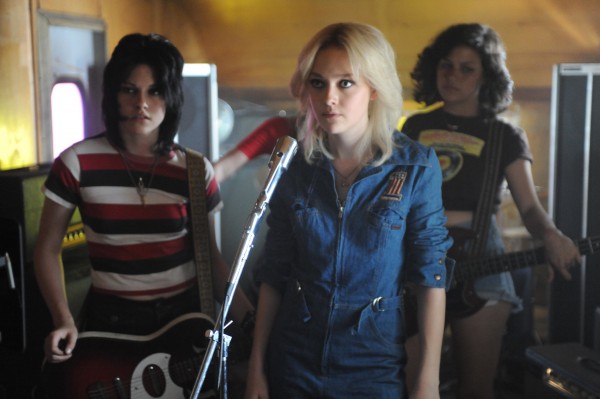
I’m unversed in the history of the band on which it is based, as much as I am unversed in that of Joan Jett. The Runaways calling card was never going to be its ability to show us a great “biopic”. In fact, if you do some digging you’d realise that the film is part fiction / part truth. For the first half hour two stories exist in parallels. A young Cherie Currie is an almost rebel, but not quite an outcast who’s dysfunctional family life is doing nothing to temper her obvious issues. Meanwhile Joan Jett is living life as a rebel, though she’s not “trying” as much as Cherie. She’s obviously attracted to music and has a skill for guitar playing. With the help of an obviously despicable produced Jett, Currie and three other girls form an all girl rock group. Plot details are incidental, the girls will make a rise to the top against all odd, enjoy some time there and then have a nasty fall to grace. There’s really no particular change to the age-old plot. The Runaways is a film depending on its acting, at least theoretically. Forgive me, but I couldn’t help but imagine what the film could have been with Saoirse Ronan in the role of Currie. I won’t deny that Fanning has prodigious talent, though her predilection for playing children too old for their age makes her a bit overbearing at times. I realise though that Fanning’s biggest issue is her over-technicality. She is so dedicated to turning in a good performance that she comes across as too intense at times. But this is no pan on Fannng. She settles into her character over time, in some scenes she is so excellent I almost smile to think what she could become in a few more years. She savours those moments where she gets to go all manic on us, but ironically her most poignant moment comes with a simple smile as the film’s final shot.

I’m a bit more undecided on Kristen Stewart. She does a good job, certainly. But her androgynous Joan Jett is still a little too inarticulate at times. But, I probably have my own issues with the actress to sort out since she delivers a convincing performance of a woman at odds with the world. Stewart manages to show surprising bits of character when least expected turning her character of Jett from an illusion on paper into a real woman on screen. You have to wonder if that kiss between her and Fanning is merely Flora Sigismondi’s attempt to put a gimmick in the film, but I can’t blame the film for that. Of course, as many have noted, it is Michael Shannon piercing portrayal that is the strongest. He offers one of the four performances of the year that I consider as near excellence, thus far. It’s odd that he manages to be authentic even as the character is begging to become a histrionic disaster. Sigismondi has problems with being more original than generic, but she knows how to handle her actors (or at the very least ensure that their performances flow unencumbered).

It’s easy to regard The Runaways as fleeting, and perhaps even ephemeral, but it succeeds in its attempts of solidifying the worth of Dakota Fanning and Kristen Stewart (for now at least). Perhaps, on the basest of levels, it has nothing “new” to offer – but then, some comfort can be taken in the old when it’s done with such spirit.
B
Monday, 12 July 2010
Sooner or later I’ll end up featuring an actor that we’ll end up arguing over – chances are, this is not that episode. A few weeks ago Heather and I entered a discussion in the commenting section of her blog on Jack Black. Apparently we both loathed the man. Jack Black’s appeal escapes me. It boggles my mind even more that he’s considered a celebrated comedian, or at the very least a creditable box-office draw. But am I overzealous in my disdain of him?
Prosecution, Exhibit A: Shallow Hal

Later in the week I’ll turn my attention to this film a little more, but until then I will intimate that it – along with Jack Black – does nothing but exasperate me. It remains as one of the un-funniest comedies and the fact that it garners any positive reviews only confuses more. The eponymous Hal is a shallow man who gets a “spell” placed on him so that he only sees the inside of people. Thus the fat, ugly, but sweet girl is seen as thin and gorgeous. I won’t go into the tirade on the actual film (later), but Black does nothing to improve it. It drags and his vexing lack of charisma does little to improve the situation.
Prosecution, Exhibit B: Nacho Libre

Another candidate for worse film of the decade…for me at least. It is neither “action” nor “comedy” yet it’s sometimes given the moniker of action-comedy. What an error. Even though Shallow Hal attempts (fleetingly) to take the spotlight off Black, Nacho Libre lets him do all – which only proves, once again, how unsatisfying he is a leading man and as an “actor”. It’s the sort of experience that makes you embarrassed for those involved and leaves a slight taste of vomit in your mouth.
Prosecution, Exhibit C: The Holiday

I liked The Holiday. Sure it’s not nearly as good as Meyer’s best film, but it’s a serviceable romantic comedy. I realised how little Jack Black was doing for me when, as the film neared its end, I found myself hoping that Kate Winslet would end up with the septuagenarian instead of him. Sure, he attempts to tone down his infuriating antics, but the best he manages to do is play a bland nonentity. Not to sound harsh, he’s not as horrible here as the two before – but the reason I single it out is because Black's apparent inability to play a serious romantic lead really spoiled the film at times for me, no matter how luminous Winslet is.
Defence, Exhibit A: School of Rock

I remember this most for Joan Cusack offering another brilliant take on an old character part. The thing is, the film is something of a blast and Black is good here. I don’t know if it’s because the script is tighter, I don’t know if it’s because he’s in the habitat where he should remain (with people who seem to have the mental capacity as he; no offense to children) but it works. It all works very well so that when he does (unfortunately) shift into his slapstick antics I’m being distracted by all the other good stuff around.
Defence, Exhibit B: Margot at the Wedding
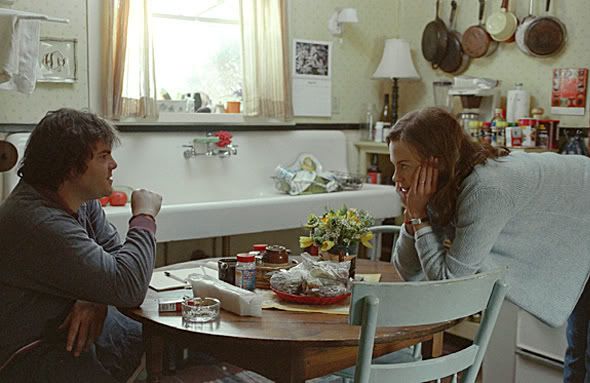
This film is oft forgotten and when remembered it is not with fondness. It’s not an easy film, by any stretch, though I do think Nicole’s quite brilliant in it playing severely against type. Yet, it’s not Nicole who’s the revelation (I already know she’s a star) it’s black pacing himself, being subtle (as much as he can) and doing one hell of a job to make me think I could have been wrong about him. Was I?
You decide. Guilty? Innocent? Am I being harsh or has Black’s career failed to impress you? Make your arguments.
PREVIOUSLY:
Sunday, 11 July 2010


As far as sixties musicals go Hello, Dolly is too often forgotten. Just a few year after Streisand's debut in Funny Girl she is decades too young for the role of the personable widow with a penchant for minding everyone's business, but with all its clunky plot points I still think it's a whole lot of fun. Streisand is no small reason for that. "So Long Dearie" doesn't resonate as much as softer numbers like "Before the Parade Passes By", but it's one of the most hilarious cinematic musical numbers I've seen. Enjoy.
Saturday, 10 July 2010
I was in the process of tabulating the films I’d seen in the last decade (more on that later) and I came across a 2002 gem that’s become criminally forgotten. The film touched on two issues that often get reviewers riled up. Where, they ask, has the good old-fashioned romantic comedy gone? And why, some continue, can’t there a well made and original black film made? The fact that Brown Sugar came about eight years ago and was promptly forgotten makes me wonder if the questions asked are done so in sincerity. Last week when I caught Brown Sugar again it resonated with me much more than it did with my young self. I was moved by the honesty with which Michael Elliot wrote this subtle comedy. It was more than the exploration of a romance between our charismatic leads Taye Diggs and Sanaa Lathan but it was like Elliot’s own tribute to hip-hop, a music genre that has admittedly lost much of the panache it once held. It almost became a dual throwback, both to hip-hop’s roots and the old romantic comedies of eras long ago with two affable leads, and an eclectic supporting cast.


Interestingly neither of the aforementioned four offers the best thing in Brown Sugar. It is Mos Def (a rapper) and Queen Latifah (another rapper) who provide Brown Sugar with a brand of comic relief that is neither over-the-top nor annoying. Latifah has always been charming, and with a small role she sizzles whenever on screen. But it is Mos Def in particular, oddly one of the best black actors around (see Cadillac Records, Be Kind Rewind, Something the Lord Made). There’s a particular scene that attracts me both as a fan of his and as a movie buff. While berating Andre for his insolence with Sydney he says,
“I'm not the Humphrey Bogart in this. I'm the Peter Lorre. I'm the sidekick character. You the Humphrey Bogart. You had your opening. You know what I'm saying? She wanted you to stop her from marrying the old dude, but you let it ride, you know? Same thing Bogey did, man. You're the same dude.”
Kudos, to Elliot for offering us this allusion that’s neither too on-the-nose or too pretentious. What’s more he’s careful to break us from the spell of romanticism to reality as it continues...”
Dre: “Man, don't be dissin' Humphrey Bogart, man.”
Chris: “Why not?”
Dre: “'Cause he's Humphrey Bogart. He's the man. Yo, he was fightin' a war. That's what they did back then.”
Chris: “You know what he needed to do back then? He needed to stop fine-ass Ingrid Bergman from gettin' on the plane with the corny dude. And then, he gonna walk off in the fog with some other dude. Come on, man. With another dude, in the fog? Come on. Two grown men walk off in a fog, you don't know where they goin'? Think about it, man.”
Dre: “You smoke too much grass, man.”

"What's the matter, smartass, you don't know any fuckin' Shakespeare?"
0 comments Posted by 2011 at 10:55You can’t help but feel self conscious about the movies you like sometimes, and with The Departed I’m not sure if it’s me being self conscious about liking the movie (because most everyone seems to like it) or if as someone who’s quite fond of Scorsese I’m either not as fond of (or not versed in) his older work – which all the “important” people agree is his best stuff. Thus, I always feel a little uncertain when I say that The Departed is my favourite Scorsese film. It’s a weird feeling. I’m simultaneously embarrassed because it seems like a peculiar choice and yet it seems generic. It’s odd because it’s new and everyone says new films can’t be classic, and it feels generic because those unversed in Scorsese often cite The Departed as his greatest because they don’t have patience for his earlier “meandering” (their words) narratives. I mean, I have seen the essentials ones (the boxing one, the gangster one, the Christian one and the New York one) but strangely it’s the Bostonian interpretation of a Chinese adaptation that has my allegiance. But why should I worry? The internet is the place for unfounded allegiances, no?

"The Departed brings us what I’d consider another piece of movie immortality. Scorsese is known for his affinity for the gangster genre, and not since his Goodfellas has one so remarkable been made. The score and soundtrack where characters of their own, while coupled with a cinematography that was gritty and abrasive with an expected edge. Every once in awhile you take a trip to the theatre and are lucky enough to have an actual experience. This was one of those rare occasions."
And, really, if the mob approves I must be on to something.


"In the Scorsese gangster canon, GoodFellas tends to reign supreme. And yet there’s another film he’s made that’s every bit as edgy, brutal and grimly funny as that de facto classic. With its talent-heavy, all-star cast (DiCaprio and Damon hold their own against Jack Nicholson), The Departed, Scorsese’s twisty Infernal Affairs remake, is an exhilarating mix of find-the-rat stunts, mind games, gang rivalries, dirty politics, storylines that bend back on themselves and two deaths so shocking they keep smarting days, even weeks, later. And because it’s Scorsese, everything is set perfectly to a soundtrack that funnels complex emotions into songs."
I’m glad I’m not the only one smarting at those two deaths, and kudos to Meredith for bringing up the music which is so often forgotten – and it’s not subtle, so I don’t know why…And, I know – dear God, I know – that The Departed doesn’t exactly thrive on any subtlety in particular, especially when anyone named Baldwin, Wahlberg or Nicholson is on screen but with so many characters to sort out we don’t have time for subtlety even if I still question the relevance of that hazy scene with Costello and the prostitutes… (I find the actual scene almost as funny as Monahan’s screenplay which reads “Costigan fucks…and fucks weird”. Okay then)…. But, still, amidst all its obvious weird obviousness I like how The Departed is dedicated to using every detail it brings up. Like the envelope for “citizins” turning up later, or even the simpler things like the cranberry juice quip – what, are you getting your period? I like how even French is in on the joke. It’s a lucidity (in the face of obvious lunacy) that’s a bit satisfying when you consider that besides Madolyn and Queenan every character is more than a little disturbed. And to be honest, who’s to say they’re not either? There is little that’s particularly hilarious about this gritty film, but Scorsese has such a talent for finding the humour in the strangest places. Sure, it derives from Monahan’s script but Scorsese milks it just right without going overboard. It’s like that scene where Billy shoots the guy in the knee and he starts screaming, “I thought I was supposed to go into shock. I’m not in shock. It fucking hurts. It fucking hurts.” Excise that scene and you could put it in any offbeat violent comedy. The Departed isn’t willing to fall into the boundaries of what it should be, Monahan’s too atypical for that and Scorsese too wise, and thus when I hear it referred to as a crime drama, I’m not too sure that that’s the subgenre it would fall into.

Maybe I do feel the slightest bit of dissonance when I say it’s my favourite Scorsese, but ultimately I’m not really that bothered. Especially when the refreshingly honest Darren from The M0vie Blog has this to say:
"I'll provoke the ire of Scorsese fans for saying this - but I think this can stand tall and be counted amongst the best of his impressive filmography. I'm also very pleased with Shutter Island, though, so what do I know? At once a return to the mean streets that defined the early part of his career and yet strangely a more stylised film, this is the movie I watch once a year with my girlfriend. The first time we watched it, she had missed it in the cinema, so I booked a large room on campus, a projector, some popcorn buckets and drinks holders from a cinema, and surprised her for Valentines Day with a screening. Casino Royale may have been the film we saw on our first date, but I think The Departed will always be "our" film."
Although I’m a little dubious of Darren’s choice of it as a film to gain the title of a couple’s film (really Darren, isn’t that just a little umm, sadist?) his words do make my thoughts a little less "dissonant"... All his films aren’t made equal, but Oscar or no Oscar The Departed is good one from Marty.
We’re getting closer to the top, The Departed is #7. How does it stack up against Scorsese's other works for you? How much do you like it either way?
*I guess I wasn’t as closemouthed as I thought I would be; this turned into quite a ramble – it’s the longest of the reviews yet.
Friday, 9 July 2010
I've still got Harry Potter on my mind (I'm in the process of rereading the last book for the umpteenth time). I'm going to miss these films when they're gone, even though they often get me riled up with their faults, but I digress. One of the things I love most about the Harry Potter films is their tendency to have excellent Brit actors popping up to make my day. I love the British, what can I say? Herein lay my favourite adult performances; and by adults I mean anyone who never donned a Hogwarts Students' Robe.
#15: Jason Isaacs as Lucius Malfoy
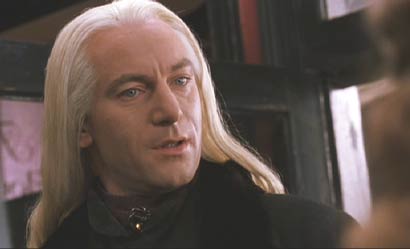
"Good" looking but still ugly, charming but repulsive and with that horrid hairdo he was good in the role. It's easy to forget him with all the great adults popping in and out, but he deserves some notices.
#14: Timothy Spall as Peter Pettigrew

This probably comes easy to him, but that doesn't make it any less good or enjoyable. His face alone annoys me (that's actually a compliment).
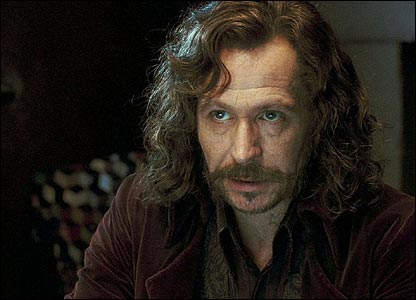
#13:Gary Oldman as Sirius Black
#12: Kenneth Branagh as Gilderoy Lockhart

It's weird how you could play the "Six Degrees" game with the actors in this movie, two of Branagh's love interest appear down below - but I digress. He plays with all the comedic glory it deserves and yet doesn't annoy us as much as this egotistical prick should. Good stuff.
#11: Julie Walters as Molly Weasley

Often, unfairly, ignored because she's never front and centre. Oh, but her personability is priceless. She gets the characterisation down pat (everything Rowling intends) and is just too sincere for words. I really hope we get to see her kill Bellatrix (though of my loyalties are divided, this is HBC).
#10: Ralph Fiennes as Lord Voldermort

Well I have a longstanding appreciation for this man's talent, and then he comes along and plays Lord Voldermort...how exactly does one resist that? Cold, frightening, charismatic and just downright nasty. I love it.
#9: Emma Thompson as Professor Sybil Trelawney
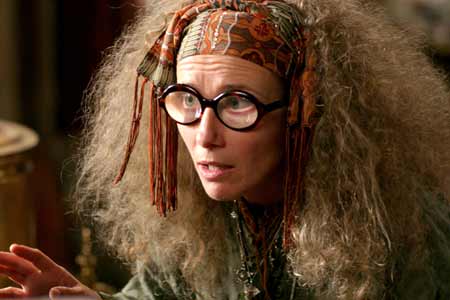
This was such a weird experience, seeing the always composed Thompson (Branagh's ex) as a bumbling teacher? Who knew she had such excellent comedic timing? There's a moment where she's being thrown out of the castle in the fifth installment that I always remember fondly.
#8: Alan Rickman as Professor Severus Snape

I hate that he gets typecast but I love when he gets typecast. He just knows to find that sinister root that makes him formidable and yet strangely charismatic. The hair doesn't do much for him, but I suppose he doesn't care.
#7: Miranda Richardson as Rita Skeeter

Oh how I wish she had more to do, every moment she appears on screen I can't look at anyone BUT her. She's just too enthralling for her own good and though we know she's wicked throughout we too are almost charmed into wanting her to intereview us.
#6: Maggie Smith as Professor Minerva McGonagall

She does it in her sleep, but she does it well. This is another performer I hope gets her chance to shine in the final installments, it's another example of casting genius. Shrewd, kind, but with an iron grip on her house.
#5: Richard Harris as Professor Albus Dumbledore I

Despite what it seems he's the perfect representative of Dumbledore as far as the books go. Old and wise with a talent for non sequiters, but with power behind those seemingly benign looks of his.
#4: Helena Bonham Carter as Bellatrix Lestrange

Nepotism? You bet your ass. This is Branagh's second ex on the list (that we know of). Perfection is an ideal but this is just divine. Manic but arresting, disarming (in more ways than one) and with a penchant for fickle childishness that just thrills me. Sometimes I think the Deather Eaters are calling...
#3: Jim Broadbent as Professor Horace Slughorn

You're never prepared for the emotion he brings to the role, thus his final appears always surprises you and then it saddens. He has excellent comedic timing, but it's the emotion that turns him into one of Harry's best teachers.
#2: Imelda Staunton as Dolores Umbridge

#1: Michael Gambon as Professor Albus Dumbledore II

Ironically, I think he's wrong the part. Too harsh when Dumbledore should be less overt, too loud when he should temper, and yet he finds himself in The Half Blood Prince and turns this character into something else - not Rowling's creation, but his own. That image of his pseudo-Moses moves in the caves and the drinking of the potion stay with me. Just excellent.
Great Adults That Could Have Been: Kristin Scott Thomas as Narcissa Malfoy. Imagine that.
Okay, now the fun part, with the exception of Oldman these people all have history:
Richard Harris is deceased so he goes first. Incidentally, he starred in Mack the Knife (1989) with Julie Walters who went on to star in Becoming Jane (2007) with Maggie Smith who had starred in Gosford Park (2001) with Michael Gambon who was in Sleepy Hollow (1999) with Miranda Richardson who was in Enchanted April (1992) with Jim Broadbent who was in Vera Drake (2004) with Imelda Staunton who was in Nanny McPhee (2005) with Emma Thompson who was in Sense & Sensibility (1995) with Alan Rickman who starred in Sweeney Todd (2007) with Timothy Spall who was in Hamlet with (1996) Kenneth Branagh who had starred with HBC in Twelfth Night ( 1995) who had starred with Ralph Fiennes Wallace and Gromit: The Curse of the Were Rabbit (2005) and who was in The End of the Affair with Jason Isaacs (1999)
...and of course the pairings continue like HBC and Emma in Howards End or Emma and Maggie and Ralph in Nanny McPhee & the Big Bang or Maggie and HBC in A Room With A View or HBC and Michael Gambon in The Wings of the Dove or Rickman and Thompson and Imelda Staunton in Sense & Sensibility.
Do you think they'd chat on set? I did this from memory, maybe there is a movie with Oldman and one of them...anyone?
Take your pick. Which adult tops your list?
Subscribe to:
Posts (Atom)