|
|
|---|


Showing posts with label seventies. Show all posts
Showing posts with label seventies. Show all posts
Friday, 8 April 2011
I’m doing a journalism writing course this semester at University, and on Wednesday our lecturer made us watch Pakula’s 1976 All the President’s Men. It’s a fine example of journalists at work since the adaptation is so devoid of the most obvious Hollywood-ization that most true-stories have today – sometimes, I must admit, to my exasperation.

Hoffman and Redford are two of the most conventionally “seventies” actors and the idea of them working each other is spirited. The thing, the best thing about All the President’s Men is also the worst thing about it. In its staunch upholding of the truth it seems to be devoid of characters, which is – incidentally – what makes me such an admirer of Hoffman and Redford here. They have little to work with, but they make it work excellently. I like Redford, but even at his best I always like him with reservations. And, he’s not at his best here – but he’s good.
 The two manage to make simple interviews come off as well acted arcs; the best of which occurs opposite Jane Alexander in a head-scratcher supporting actress nomination. She’s much better than the role, but it’s still one of the oddest acting nominations I can recall. Oddly, Robards, with a similarly small role manages to carve something much more indelible. No, not worthy of that Oscar, but oftentimes one of the highpoints of the film reminding you that these are real people and not just the means to an end in bringing down a government.
Like so many films that retain that quintessential feeling of Americana I often wonder how much more I’d like All the President’s Men if I was an actual American. To its credit, though, what emerges loudest from the narrative is not a pride that is nationalistic but journalistic – garishly, at times. Just like many would say that Saving Private Ryan offers a ferociously authentic look at war All the President’s Men does the same for journalism – although not ferociously. It’s content with showing the unglamorous nature of the job.

This is perhaps what makes the film itself sort of paradoxical for me. It doesn’t maintain the major tenets of the cinema, it’s palpably a non-fiction piece but yet its cinematic aspects are excellently done, its cinematography and score for example – though unobtrusive in both cases – is excellent. But, remember that adage about things not being as good as the sum of their parts? I get that distinctive feeling with All the President’s Men. It’s a fine example of filmmaking that is immediately admirable, both for its cinematic attributes and for the way it pushes boundaries with the form of storytelling – the screenplay is a beauty. But, there’s something distinctly cold about it, soulless even – but I still won’t deny that it’s a fine film.
What do you think of Pakula's film?
Friday, 15 October 2010
Kramer vs Kramer is one of those dozens upon dozens of films I sought out because of the Oscar attached to their name. I’m always looking to get edified on the tenets of good cinema, even though I can now admit that Oscar does not always equal good cinema. Kramer vs Kramer is as simple as family dramas. Joanna Kramer is unhappy in her marriage and rashly leaves her husband and six year old son. Over time Ted forges a strong relationship when Joana returns looking for custody of the child. When I reviewed the small town duo of Rebel Without a Cause and Picnic I noted that both films were deeply rooted in the zeitgeist. I figure that with the changing parental norms of the seventies Kramer vs Kramer was just as zeitgeist in its way, and in theory I suppose Ted's accomplishment is important for the time. The thing is it’s mostly all lost on me, and the rest of the time I don't really care.


Was Kramer vs Kramer worthy of giving Meryl and Dustin their first Oscars?
Friday, 1 October 2010
 I have a thing for British Films, no significant reason – probably the accents, but I can’t be certain. A Touch of Class is a little British comedy that just so happened to get a few Oscar nominations. I really do like A Touch of Class, it'd probably make my top 150...even though there are actually a few things that I definitely dislike about this movie, I will admit that it’s not the best movies made, but it’s still one of my faves. Glenda Jackson won herself an Oscar for this film, and it serves as proof that when comedies are done tastefully they can be quite successful with the Academy.
First off, I should say that I like George Segal. He was robbed of an Oscar for Who’s Afraid of Virginia Woolf?, but that’s all old news. He was also robbed of an Oscar for this gem, here. Robbed, I tell you, robbed! I mean Glenda won an Oscar – not sure if she would have gotten my vote – but I didn’t mind. But he was better than her. A Touch of Class is pretty straight forward. While in the park one day a man and woman bump into each other, and for a few days after that this certain man and certain woman keep on bumping into each other until they decide to have a romantic rendezvous, he’s a married American - Steve - and she’s a catty British woman - Vicki. It’s the seventies so extramarital affairs are all fine and dandy. He has this really annoying wife that just gets on my nerves, but eventually he is able to get to the airport to meet the woman. Naturally (because this is a comedy you see) their journey to romanticism (or sex as we know it) is filled with a whole lot of madness – I won’t go into that. Eventually they do have sex and he’s offended when she doesn’t think that it’s the best night of her life. They decide to go home now, they are not hitting off. Eventually (as this is a romantic comedy) they end up arguing which leads to explosive sex and they start to fall in love – but they don’t know it yet. One of Steve’s friends (Paul Sorvino in a very blandly acted part) warns him about these dalliances which only end in heartbreak, but he doesn’t think they will become emotionally attached.


I’m not a sucker for happy endings, but I was so pissed at the ending of this movie. Why did they have to break-up? I mean, okay maybe they wouldn’t have gotten married, but how about a nice uncertain end like Eternal Sunshine of the Spotless Mind. Poor George Segal. I realise I’ve been rambling and you’re probably wondering – Why do I like this movie? Don’t get me wrong – it’s a good movie. Glenda Jackson is great and very hot – and for some inexplicable reason she reminds me of Cate Blanchett – it’s probably the protruding cheekbones, bless them… and George Segal as I said before is a really good actor. He’s really underrated, I mean he’s not good in everything – but when he’s good, he’s excellent., and he was excellent in this. Shame, it's not remembered more often.
Wednesday, 19 May 2010
One of my favourite scenes in Annie Hall happens some time into the film, although chronologically it’s somewhere near the beginning. Annie drives Alvy to her house after a game of tennis. They seem to like each other, but Alvy’s so antagonistic and Annie is such a ‘dweeb’ they’re uncomfortable. Annie starts telling him about a relative of hers that had narcolepsy. Diane’s Annie is there telling the story in all her affable weirdness, and halfway through you get the distinct sense that Annie doesn’t know where the story is going – or why she started telling it in the first place. It’s a weird moment, but I often think if you’re not a fan of this scene you’re not a fan of Annie Hall. For me, Annie Hall is one of those films that has become so lauded that I often doubt people who claim to “love it to death”. It’s not that I doubt the possibility of anyone else finding it to be good. But Woody Allen, a man who is on his known is known for delighting in the off kilter, crafted with Annie Hall one of the most perversely atypical, deliciously satisfying and irrevocably original romantic comedies. Annie Hall is an anomaly – in more ways than one.

It opens with Allen breaking the fourth wall. It’s one of my favourite conceits of the film, and in a film I love so much that’s saying something. In its way, Annie Hall is akin to private conversations with a neurotic. It’s almost as if retelling his story is a cathartic way for Alvy Singer to deal with his issues – and there are so many of them. Few filmmakers are as comfortable in their idiosyncrasies as Allen. Each director I admire has their secret weapon – Kazan has a knack for sympathising with the disturbed and disturbing, Scorsese has a gift of finding the broken and making them heroic, Ivory has the flair for making the past seem so real and potent and Woody knows to make the audience identify with the idiosyncrasies in his characters. It’s a love or hate thing, if you don’t like one Woody film chances are you won’t like most of them, but I do (on both counts). It’s easy to miss the cues while we’re caught up in the hilarity of Alvy’s return to his elementary class, or the comedy of his romancing of Annie. There are little things, like his inability to say “I love you”, or just his natural tendency to find the worst in any situation. But Allen never lays it on too thick, he never creates villains – his characters are always, completely, human. It’s one of the reasons I’m surprised at Annie Hall’s success – it’s not exactly escapism. In the face of its irreverent humour, there’s a mire of uneasiness to make you ponder…

Annie Hall hinges, completely, on the performance of the leads. Sure, the role was written for her – but that doesn’t make her contribution any less valuable. Like Woody, it’s her knack for being pleasant while being annoying that makes the performance such a treasure. Return to the earlier scene I cited, Diane gives one of my favourite quotes when she tells Alvy, “You’re what Grammy Hall would call a real Jew”. It’s a moment that I love not only for Alvy’s excellent reaction (more on that later) but for Diane’s ability to say so much while in reality saying so little. Acting is not just knowing what to do, but it’s knowing what not to do. Diane’s Annie is completely real (and she probably is) because she gives us those weird tics and the moments we’d least expect it, and at the moments that we’d typically expect it she holds back. (She reminds me of another deserving Best Actress winner in that way.) Annie isn’t a particularly nice person, but she has a quality that’s definitely inviting. It’s the same with Woody, though he’s not as understated as Keaton (but nonetheless excellent). I don’t know what it is about Oscar not wanting to give actors Oscar for acting and directing in tandem (Beatty and Olivier both had split decisions). His performance is just brilliant to me. He’s gifted with that brilliant dialogue, but it’s those smaller moments where he completely sells his emotions through his face that always get me. There’s a truthful whimsy that’s incomparable. He’s never been so in touch with his character.
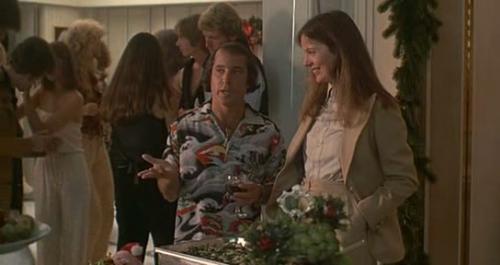
I’m always surprised that Annie Hall won those Oscar. It’s one of those moments of lucidity (becoming rarer and rarer) where they give in to the less obvious. I suppose that Woody Allen is not for everyone. Just like all who gangster films won’t like Scorsese, or those who like epics won’t like David Lean and on and on. But I am in awe of the man, and I adore Annie Hall; it’s #22 on my list of favourite films.
Subscribe to:
Posts (Atom)