|
|
|---|


Monday, 21 February 2011

 There are those rare moments where Amenabar seems to lose sight of his general objectivity, but at the height of its success Agora really is an objective attempt at the historical epic. The destruction of the library emerges as the centrepiece for the film in more ways than one. On the technical aspect, the scope of it is peerless. The production design, visual effects and cinematography are all essential in establishing that pandemonium as Hypatia and her lot make their attempts to salvage the “important” works. Then, there are the smaller thematic arcs – like the parting of ways between Davus and Hypatia. It’s the solitary moment where Weisz’s Hypatia is not calm, elucidating just how much she feels for knowledge. It’s a perfect coalescing of technical and emotional aspects and easily Amenabar’s strongest portion of Agora.
  One of my sisters said, of this scene, that it’s so good because each of the five actors is doing some of their best acting – and it’s true. It’s Annette’s scene, yes, but it’s not hers alone. From the onset of Nic’s attempts to be chummy with Paul, you already get the feeling that he’s a bit uncertain of himself and Huthcerson and Wasikowska’s facial responses to the opening of “Blue” is perfectly played. And, then, there’s Julianne – so guilty, and so vulnerable. The thing, it’s not just the acting (and writing) though – editor Jeffrey Werner and Cholodenko know just when to cut the shots and it all leads into Nic’s discovery of the hair. Everything works just brilliantly.
 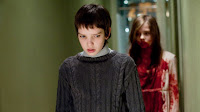 From the moment that Elias Coteas’s policeman raps on the door in Let Me In, with Owen inside you know that things are going to go awry. Reeves is a master of atmosphere, which is his most significant calling card in making the tension so palpable in Let Me In and the entire ensuing scene works because of the richness of the atmosphere. That doesn’t lessen the profundity of Kodi-Smit McPhee’s work, though. It’s his strongest scenes, and although it’s mostly a reactionary one he’s excellent. He has the difficult task of portraying that sort of bathos you’d expect from a child in this situation, and his aghast response to the Police’s death is one of genuine fear and sadness, and it’s all aided by Giacchino’s fine score.
 Is it possible to resist the epic brilliance of that final battle in Scott Pilgrim vs the World? It’s the climax of the film, the one those videogame geeks (the film’s ostensible target audience) would have been waiting for, that scene that’s unashamedly indicative of its roots and you sort of get the feeling that Wright, too, can’t wait for this moment to toss out all his tricks. And, usually, you’d think that tricks don’t necessitate goodness, but it’s all part of the atypical way of Scott Pilgrim vs the World – the tricks are an essential part of it. Watching how Scott approaches the single situation (before and after) and seeing how his approaches lead to the domino effect of reactions from the characters is fine example of Wright ensuring that his moral themes hit home without being maudlin. Perfect.
 I still maintain that Shutter Island would have been a much better film (albeit an unsatisfactory adaptation of the novel) if it ended here. Even if you’re not aware of what is going to happen, you know that the film is building up to a specific moment – this being it, and everything good about Scorsese and DiCaprio (as far as Shutter Island is concerned) occurs here. The atmosphere is potent, but not overwrought and Michelle Williams so just excellent opposite DiCaprio here. It’s a true credit to DiCaprio that he manages to make this moment play out without undermining the necessary emotional connection.
 Then there’s our first meeting with that “awesome sperm donor”. Me and my mind can’t help going to dirty places when they start in on their tongue story (but they’re begging for it) and like everything in The Kids Are All Right we’re being prepared for every major plot point. Joni and her latent resentment of Nick, Paul and Jules potential bonding the vague discomfort of everyone – especially Paul. It’s one of the reasons I singled this out as the best ensemble, they’re always playing off each other – and so excellently, too.
 Because The Social Network is so inextricably linked with the personality of its protagonist – ostensibly cold, vaguely mysterious, sometimes confusing – it’s essential that Garfield’s Eduardo is there to offer a semblance of balance. That’s why, despite the fact that Eisenberg is the film’s best actor, the film’s strongest scene (in my eyes) depends on Garfield just as much – more, perhaps. The way that The Social Network is written ensures that it’s all building up to that scene where Eduardo and Mark part ways, and you can’t fault Sorkin for pithy dialogue – it’s required here. There’s something great about that “lawyer up, asshole” line that’s all sorts of awesome.
 It’s not that Animal Kingdom is lacking in a wealth of strong scenes featuring the entire ensemble (both meetings in the café, for example) but when I think of the strongest moments in the film I can’t help but return to a moment that should play as just the slightest bit superfluous, but never fails to rouse my attention – Craig’s death. It’s possible that it’s because Stapleton gives my favourite performance of the film that makes me even more appreciative of this scene, but everything leading up to it – Craig’s argument with his friend, his growing paranoia and then the threatening advance of the police is proof not only of Stapleton’s performance but Michôd’s fine direction.
  I find it hilarious that my favourite fight scene in The Fighter has little to do – directly – with Micky’s boxing career: Charlene vs the Seven Sisters from hell. The scene really begins at Alice’s home as she and her daughters prepare to wreak havoc on Charlene for derailing their plans with Micky. From the moment they get into that beat-up car you know that what’s imminent will be marked by that deliberate dry humour looming over some of the strongest moments of the film. Amy, so very fearless here, is brilliant as her Charlene clashes with the sisters. Russell is so smart, though, and he knows that the scene holds more importance than just the hilarity to be gotten from the hillbilly antics.
 Even though Nicole, easily, gets best-in-show citations in Rabbit Hole, I still like to think of its ensemble as the heart of the drama – which makes that bowling-alley birthday of Izzie such a perfect scene to encapsulate all that I love about the movie. Teller and Oh (both good) don’t show up here, it’s all about the actual family. Blanchard, forever on the sidelines with her subtleties, is so good when she reacts to the gifts and Becca watching Izzie respond is a good example of Nicole being completely in tune with her character’s inclinations. I love that blink-and-you’ll-miss-it bit of conversation that Howie and Nat have (I wonder what their relationship is like) and of course that final blow-up between mother and daughter. Wiest and Kidman are so wonderful opposite each other.
Thursday, 10 February 2011
Encore Awards: Visual Categories; Part Two (Visual Effects, Cinematography, Editing)
0 comments Posted by 2011 at 14:02(click on photos for reviews)


 I’m still nonplussed as to why its Oscar citation here has caused such a ruckus since it’s still the first technical achievement that jumped out at me (score, costume and art direction included). It’s all part of the entire film’s manner of being paradoxically modern and traditional – simultaneously. The photography is an essential part of its entire philosophy and though sometimes it emerges as just a little too purposeful I’m wary of calling it a fault.
  Like many contemporary films, the camerawork is largely ignored but framing is of exceptional importance here. The revelation of the accident, Howie’s seduction bolstered by Barry White, that beautiful ending – all those pay heavy dues to the cinematography which is always subtle, always understated and lets the screenplay do its job. Proof that obvious garishness is not always the key to good photography. A bit like an obvious choice, no? Lord knows why it’s been virtually ignored. Even if DiCaprio has been playing in this register for a while, and even if the story is a bit pulpy that opening shot defines it all and it gets better from there. Sure, it’s not as subtle as the sets but – well – that’s the point. And extra points for every scene with Michelle Williams, just beautiful to watch
 Because Rabbit Hole depends so much on the transference of emotion and because there are only ninety minutes to play with the editing is especially important. Its montages don’t unfold as obvious cinematic tricks, and like the film there’s an easiness to it all that is – unfortunately – easy to ignore. When you think of guiding the pace of the story, and of giving emphasis, though – Klotz’s work is palpably good.
  It seems a bit ADD, just like its protagonist and that’s probably the point. The deposition scenes are such an obvious example of him getting a brilliant playing ground and he milks it for all it’s worth getting those precise shots, cuts that supplement Sorkin’s rapid screenplay. Sometimes his choices seem weird, but that’s because there’s SO much going on in this one, watch it multiple and you begin to realise just how seamless the scenes flow into each other.
Wednesday, 2 February 2011
Encore Awards: Visual Categories; Part One (Makeup, Costume, Art Direction)
0 comments Posted by 2011 at 02:01


 Where do the visual effects end and where does the production design begin? Ah, questions – questions. I feel a bit annoyed that because of the (admittedly good) visuals a modern day piece like this gets the praise for art direction than most contemporary flicks to get but I can’t stay mad because the production work is especially good – and it should be, the story demands it and even though there’s a bit of a symbiotic and on that count Nolan and his team deliver admirably.
  Sue me, but I have a penchant for pretty things so I find the entire production design here a bit difficult to resist. Everything is just so lovely to watch, but what’s really surprising is it never turns into one of those annoying ornamental period pieces where the film is just begging you to pay attention to it. Everything in Logue’s office works so well, and it’s serving the story, being regal but not officious – functional but still appealing; a bit like the monarch himself.
 I’d intimate that it does what Black Swan does a little better – on the art direction front at least. Notice how Mimi and Julia almost have the production design of their houses defining themselves (and it’s not unsubtle like the costumes.) Taylor-Wood is already interested in creating a world that’s a bit more fanciful than realistic and the production design doesn’t exploit this – but does it in an unexpectedly subtle manner.
 Like Inception the tie-in with visuals is potentially dense, and like Inception it’s the sort of film where creation of atmosphere is imperative to the success. It’s not as overtly dazzling, but it’s not really supposed to be. It underscores, but never overpowers the story so that when those very literal plot revelations come the production design is there to back it up – but not ham it up.
 Wednesday, 26 January 2011
And my recap of the official “Oscar” categories begins. I really can’t overstress the dissonance I feel about the crop of films we’ve been offered up this year. I don’t know if I’m getting too jaded for my own good, but it’s becoming increasingly difficult to surrender to the worlds of film generally and though this year’s supply is not terrible it’s a situation of too many “goods” and too few greats.
But, I’ll save all that rambling for later categories.
I was musing on a format, and instead of sticking with the more aesthetically pleasing (and altogether easier to digest) table format I’m sticking with general paragraphs, because even if I’m not in love with many films this year I find that I’ve managed to get even more voluble Be warned, excess verbosity ahead. (Click on the photos for reviews, where available.)
SOUND EDITING
In short, this recognises the artificial creation of sounds that are inserted into the film.
THE NOMINEES
127 Hours (Hugh Adams, Ben Barker, Nicholas Becker, Glenn Freemantle)  If I was petty (no, your comments aren’t necessary for that particular anecdote) I’d ignore it here because the film is making leaps and bounds just to ensure that the sound design is as obvious as ever. But that would be silly, a) because it’s dumb to ignore good work even if it’s in an obvious manner and b) I don’t think the sound team would especially snubbed by an exclusion from me. So, I won’t cut off my hand to spite my arm – and snub it here. (That was a bit distasteful no?)
Inception (Paul Berolzheimer, Richard King, Michael Mitchell)
It’s a bit like 127 Hours in the sense that it’s difficult to ignore, but there that obviousness of the sound design is an absolute necessity which they use for their benefit. Any dream world depends on the smallest of things and the sounds become amplified to the point that they’re just as important as the things we see.
Robin Hood (Wylie Stateman, Mark P. Stoekinger)
The sound-work in Robin Hood, in its way, is a sort of representation of the good and bad in the film. Like Scott’s entire vision of subverting the usual swashbuckling Robin of Loxley, the sound is defined by the simplest of things. Yes, there are the obvious horse hoofs and whatnots, but even the silence is a sound effect in itself – as faulty as the film is at times, it’s one of the most unfortunate snubs in the technical department.
It works as well as it should in the more obvious video-esque scenes because that is – on the surface – the film’s key aspect, but smaller things like the reverberating sounds in Scott’s alter universe or that first party make good use of sound. You’d expect them to be a whole lot less subtle with it, but it’s all quite smoothly handled.
From the heavy breathing, to the raging storm it all contributes to the very unsettling tone pervading the island the film. Visually we get the sense that something’s off, the effect of the sound, though, make it positively distressing.
FINALISTS: Agora doesn’t thrive as much on its sound editing as its mixing because unlike most sword and sandal epics it’s not that external – but it’s still a worthy contender; Green Zone, too, doesn’t use as many effects as you’d expect, but this is one of those entries that you’ve have expected to translate to Oscar love; and kudos to How to Train Your Dragon for neither exploiting the animation and giving us a talking dragon, and for realising that are interesting effects much more striking than dialogue.
SEMI-FINALISTS: Black Swan; Harry Potter & the Deathly Hallows
SOUND MIXING
The coalescing of all the sounds - music, dialogue, effects.
THE NOMINEES
Because that centrepiece of the library being destroyed functions as a climax for the entire film I can’t help but zero in on that specifically – but with all those wild mob scenes (enhanced in the second half) the sound mixing becomes a key aspect in showing just how much Alexandria has changed.
Black Swan (Ken Ishii)
Even if the screenplay is lacking on occasion Aronofsky is well aware of what to do to amplify the terror that’s necessary not through words, or dialogues (or even those usual thriller-film tricks). When the visuals become saturated, the sound emerges as even more pivotal in representing Nina’s delirium.
The Ghost Writer (Jean-Marie Blondel, Katia Boutin)
True, I’m sort of in love with Desplat’s score so there’s that possibility of nepotism when I take note of the way that Desplat’s score blends beautifully into things like the rustling of the waves. But, those very blends are pivotal in evoking that ultimate sense of faux-dread mirroring Polanski’s tone that’s never sincerity in trepidation but always spilling over into something jokingly sinister.
Green Zone (Jorge Adrados, John Hayes, Simon Hayes, Markus Moll)

It’s an ideal candidate for its sound work – after all, this is the same admirable sound team of the Bourne Trilogy. The blending of the sounds is excellently done, and it’s a shame that it’s being ignored because everyone forgot that there was another Iraq film coming after The Hurt Locker. Madness.
Like the work in The Ghost Writer the blend between score and effects is excellent – it fits the thriller-ish nature of the film too knowing just when to step back and wait for the right moment to jump the audience
FINALISTS: Sometimes in 127 Hours you get the feeling that the mixing’s just a little disingenuous and what should be smooth flowing ends up as a little jarring – just for the hell of it, it’s still outstanding work but still...; I’m a bit sorry that I couldn’t get a spot for How to Train Your Dragon if only because those last fifteen are kind of awesome; and then there’s Let Me In which has a climatic that depends more on the sound than the visual (oddly) and to brilliant results
SEMI-FINALISTS: Inception; The King’s Speech; Robin Hood; Salt
ORIGINAL SCORE
NOMINEES
Dario Marienelli Agora
It’s not as in keeping with its period as much as his work in Pride & Prejudice, but it’s another aspect of the film making this old story futuristic. And it’s never too much – he knows the wisdom in less being more.
Alexandre Desplat for The Ghost Writer
More than any other technical aspect Desplat realises just what Polanski is going for and his score becomes a key to understanding what we’re supposed to take away from the film (case in point: the beach scene).
I’m actually surprised that despite its effusiveness Desplat manages to never turn this into something overbearing. You wouldn’t think that Bertie’s story demands music but Desplat’s work is flawless.
It seems as if the score is almost the part of Becca that she’s unable to convey to us with words. That entire scene where she washes Danny’s clothes is buttressed by the music which is ostensibly soothing but still very much on edge.
Trent Reznor and Atticus Ross for The Social Network
Over appreciation for The Social Network aside resulting in this getting recognition, in the grander scheme of things I don’t mind because the score IS that worthy of appreciation. Sure, the opening scene is Sorkin’s dialogue but the film truly begins as Mark travels back to his dorm room and from then – to the end – the music just merges beautifully with the narrative. Always striking, and yet always subtle.
FINALIST: Michael Giacchino for Let Me In
SEMI-FINALISTS: Rachel Portman for Never Let Me Go; Kjartan Sveinsson Ondine; Carter Burwell for True Grit; Murray Gold for Veronika Decides to Die
ORIGINAL SONG
THE NOMINEES
“Bound to You” from Burlesque (Christina Aguilera, Samuel Dixon, Kate Sia)

It’s easy to ignore it as a run-of-the-mill love song, but the union of music and lyrics is beautiful and though it loses points for being wasted because Ankin seems unsure of the precise moment to get romantic – it’s still the most laudable effort of the show.
“Welcome to Burlesque” from Burlesque (Matthew Gerard, Steve Lindsey, Charlie Midnight, John Shanley)
I’m surprised that this one in particular never took off – it sort of the essence of what they’re demanding in the song category. Okay, so maybe Burlesque isn’t as mysterious as Cher tells us but it functions excellently as the first real number of the film.

Leave it to Chris Martin to create a country song that evokes the nostalgia necessary for country music and yet is nowhere near as standard as you’d expect. The music invites you in and then the lyrics send you on another spin. It’s all very sedate, but that makes it all the more moving.
“Mother Knows Best” from Tangled (Alan Irwin, Alan Menken, Glenn Evan Slater)

More than any song from the film (heck, any song this year) Menken shows here why the music is just as important as the lyrics. He matches the very ambiguous lyrics with an even more discordant melody that has you tapping your feet AND feeling unsettled.
“Garbage Truck” from Scott Pilgrim vs the World (Beck Hensen)
All the music here is completely in touch with the quirkiness of the film and this one works better than all, not only because its’ the nicest one to listen to (though, perhaps, that’s debatable) but there’s something hilarious about it and it wins points for fitting the best in the action around it.
FINALISTS: “I See the Light” from Tangled sure does sound pretty for the most part, but it’s exasperating how Menken dilutes his usual cleverness. Sometimes the lyrics are just too tepid and then there’s the whole fact that the entire chorus seems to defy logic; it reminds me a bit of “But I Am A Good Girl” from Burlesque which is as nice to listen to, but loses a whole lot of its oomph when you really think it over. We get it Christina, you’re being coy because you’re not really a good girl.
SEMI-FINALISTS: “Coming Home” from Country Strong is sooooo on the nose, and it’s weird that this is the one that’s remembered being “Me & Tennessee” already does everything’s it’s trying to do – but better. It’s still charming in its way, though and I was hoping for a win for “You Haven’t Seen the Last of Me” from Burlesque even if it was altogether too precise in its machinations. Cher raises its profundity, but faults and all there’s something appealing about it nonetheless – and come on, who can’t relate?
I’m actually really interested in what you thought of sound this last year in cinema, because most persons rarely cite their favourites even though sound – above all else – could be considered as the single thing that differentiates movies today from those 100 years ago. What achievements in sound do you remember fondly? And what of the music? Even though they exasperate me to no end I’m still hopelessly (hopefully?) in love with the music category at the AMPAS.