|
|
|---|


Showing posts with label Cary Grant. Show all posts
Showing posts with label Cary Grant. Show all posts
Saturday, 21 May 2011
Continuing my rambling trajectory towards my birthday…

There’s still a couple of hours left in the day so who knows? Perhaps the rapture is still imminent. So, I’ve been thinking what sort of movie high I’d like to go out with and of course it’s a Katharine Hepburn one. I’m nothing if not loyal. It’s only the other day that Wayne was talking about which Cary Grant performance he loves the most and I do love Grant, and I do worship Hepburn and if the world does decide to go kaput it’s important to go out on a high note, but more than a high note – a funny note. Enter, Bringing Up Baby.
Bringing Up Baby is always remembered as this sort of seismic moment in both Hepburn and Grant’s careers and to be honest it was some time before I really appreciated its brilliance. Humour is a difficult to establish and Bringing Up Baby is a bit paradoxical for me because I’m usually not that interested in humour that’s tinge with so much physicality. But, there’s a reason that these films get hit with the name “classic”. It’s sort of the paradigm on which more recent, and lesser, comedies of the type are based and what’s so interesting about Bringing Up Baby is how strange it is in contrast to the other Grant/Hepburn films. For once Cary is the straight man and Kate is a loony….and boy, she’s a loony.

It’s not my favourite Kate, but it’s such a fine encapsulation of her in her youth. That insistently quick manner of speech, the charming physicality, that allegedly adlibbed line, “I was born on the side of the hill.” It’s really about as faultless as they come. I wouldn’t mind dying while it plays.
More on the birthday marathon.
Tuesday, 18 January 2011

Cary's confused, it's his birthday today and no one seems interested. Don't worry, we haven't forgotten you C. K. Dexter Haven. You're still my favourite drunken ex-husband.
Saturday, 14 August 2010
I’m not a demanding movie watcher, so I don’t insist that my movies immediately begin in some eccentric manner. Nevertheless, I’m always pleased when a beginning is particularly solid and off the top of my head the opening of The Philadelphia Story is definitely somewhere in my top 3 favourite openings. It’s as concise, simple and funny as some films throughout and all without a single word being uttered. Cary Grant comes out of a house, ostensibly dressed for work with his briefcase in hand. Katharine Hepburn comes out soon after – the devoted wife, perhaps? She carries his golf clubs to him, and after a moment’s hesitation breaks it over her knees and saunters back to the door, followed by Cary who with just the slightest pause takes his hand and – with an open palm, mind you – proceeds to sock her. That’s just the beginning, just the beginning….

You can’t help but get nostalgic when you watch The Philadelphia Story; hell, I wasn’t alive in the forties but the mood evoked is so “classic” we have no choice. I’m sounding incoherent; Jose of the kick-ass Movies Kick Ass tells it better:
“They say that the movies you love grow old with you. When I saw The Philadelphia Story for the first time I was a kid who was falling in love with the movies; therefore, George Cukor’s elegant take on the screwball comedy seduced me in the most unexpected ways. I couldn’t believe people as beautiful as Kate Hepburn, Cary Grant and James Stewart could also be “earthly” and feel accessible in the way your wildest dreams can’t help but feel real when you wake up. A few years later as a socially conscious teenager I couldn’t help but admire the smart way in which the screenplay addresses the irregularities of class difference and the term “intellectual snob” became a pet cause of mine.
In that way the movie has gone from being a stress reliever to a handbook in how to handle society parties, a cruel essay about the human heart and a lesson in how to dress for every occasion. Just yesterday as I watched it again it became something new to me; for the first time I identified myself with Tracy Lord and her quest to become a human being. I couldn’t believe that a movie I’d seen countless times before was addressing something I’ve just discovered about myself. I’m honestly thrilled to discover what it tells to me the next time.”

I do love that evaluation on it. It’s one of the great things aboutThe Philadelphia Story. There’s so much going on in it that watching again doesn’t dilute its inherent brilliance. The Philadelphia Story is easily the best comedy I’ve seen, and perhaps will ever see, it is smart and yet silly and for all the serious issues addressed it’s not afraid to be self-deprecating either.

I’m always interested when plays are adapted to screen. It’s anyone’s guess how it will turn out. Will it be as “judicious” as Who’s Afraid of Virginia Woolf or Closer? – Or will it be more adventurous – a Cabaret or Cat On A Hot Tin Roof? After all – the stage is not the cinema and in adapting The Philadelphia Story Donald Ogden Stewart seems acutely aware of that. The Philadelphia Story is driven by words, and yet the characters are never relegated to talking heads even with a story that could seem convoluted to the careless viewer. Tracy is getting married to George (a nouveau riche) after divorcing a C. K. Dexter Haven (old money). Tracy’s father is shacking up with some flamenco dancer of sorts and a newspaper is editor is intent on highlighting the scandal; something the affable (yet despicable) Haven is keen on stopping. Enter reporter Mike Conner and his photographer – a Ms. Imbrie. And we haven’t even touched on Tracy’s family yet – her precocious sister, her imprudent Uncle Willie and her careless mother. It’s enough to make even the most confident screenwriter balk, yet Stewart handles it brilliantly, since The Philadelphia Story – above all else, is an actors’ showcase.
My bilingual friend from Oxford, Anahita of My Life In Film (currently on vacation) is smitten with this oldie too.
“For me, the highlight of The Philadelphia story has to be its strong cast and incredibly witty script (OK, so cast and script are usually the two most important. Still. It goes doubly for this film. Stay with me). Cast-wise – there is just utter perfection. Jimmy Stewart – one of my favourite actors – utterly shines as newspaper reporter Mike Connor, he has perfect comic timing – even making Cary Grant laugh by accident in the scene where he is utterly drunk – yet shows also a great deal of heart and sweetness, making his character a wonderful blend of sharp humour and kindness. Cary Grant is also fabulous as the ex-husband, his one-liners and answering-backs are just hilarious, especially when he plays off Virginia Weidler’s Dinah Lord, showing him just to be a big child, albeit again one who has a soft side, namely his love for Tracy (Hepburn). And speaking of, Katharine Hepburn as always is sublime – among the best two actors of the time (yes they are. Don’t argue) it would have been so easy to get lost and fade into the background, especially as a woman at the time, yet she holds her own, and creates a memorable character out of Tracy Lord. The script is peppered with funny moments – so original, sharp and witty that it’s just mind-blowing who thought of all of this hilarity – and the actors push it even further into perfection. I just love it.”
My bilingual friend from Oxford, Anahita of My Life In Film (currently on vacation) is smitten with this oldie too.
“For me, the highlight of The Philadelphia story has to be its strong cast and incredibly witty script (OK, so cast and script are usually the two most important. Still. It goes doubly for this film. Stay with me). Cast-wise – there is just utter perfection. Jimmy Stewart – one of my favourite actors – utterly shines as newspaper reporter Mike Connor, he has perfect comic timing – even making Cary Grant laugh by accident in the scene where he is utterly drunk – yet shows also a great deal of heart and sweetness, making his character a wonderful blend of sharp humour and kindness. Cary Grant is also fabulous as the ex-husband, his one-liners and answering-backs are just hilarious, especially when he plays off Virginia Weidler’s Dinah Lord, showing him just to be a big child, albeit again one who has a soft side, namely his love for Tracy (Hepburn). And speaking of, Katharine Hepburn as always is sublime – among the best two actors of the time (yes they are. Don’t argue) it would have been so easy to get lost and fade into the background, especially as a woman at the time, yet she holds her own, and creates a memorable character out of Tracy Lord. The script is peppered with funny moments – so original, sharp and witty that it’s just mind-blowing who thought of all of this hilarity – and the actors push it even further into perfection. I just love it.”

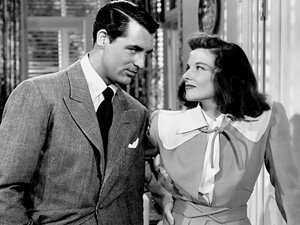
A favourite scene of mine (and there are many) occurs when Mike and Liz first meet Tracy. Not the real Tracy, but the fabricated one she keeps for the press. As she laments in an affected French accent and saunters around in deplorable fashion I could only imagine Katharine Hepburn laughing her head off inside. Phillip Barry did fashion Tracy after the first lady of cinema. Consider this with another side of Tracy – which we can’t really call the “real” Tracy either. It’s probably the film’s most iconic scene. As Mike and she drunkenly wander about the pool the romanticism of it all is intoxicating. It’s the best I’ve seen Kate (pre-1950) and the best I’ve seen Jimmy Stewart. Everyone’s on their game in The Philadelphia Story, but there’s something especial about the scenes those two share together. They do make a good couple. Yet, it’s a testimony to the two that the scene never feels like too much. Call me a blasphemer, but I prefer these moments with Stewart to the moments with Grant – which are excellent, nevertheless. It actually took me multiple viewings to realise subtle moments of intelligence in the film. As lovely as they seem to exist together, it’s obvious that Tracy and Mike are too similar. Both are too unforgiving of the world around them, and it’s up to Liz and C. K to “whip them into shape” – humanise those intellectual snobs. And the reunion with C. K. Dexter Haven is just right, it is as witty and well played as anything we’d have on screen today. Scratch that – more witty, and probably better played too.
The thing about it is that the entire of The Philadelphia Story feels like so much fun. I always remark that Ocean’s Eleven (and Twelve) was proof that a cast of good actors were willing to come together and have fun and though The Philadelphia Story’s cast is not as extensive it does it even better. It’s the sort of film where you want each cast member to be singled out for their contribution. Like Virginia Weidler’s intelligent Dinah. Preciousness in children on screen is a dime a dozen but Virginia Weidler still manages to be particularly inviting without falling into the usual traps (the newspapers were full of “innundo”), Roland Young’s Uncle Willie is a source of some throwaway humour and no one plays better off these moments than Ruth Hussey. I’m almost a bit miffed when persons don’t appreciate her as they ought. Her comedic prowess is in opposition to Kate’s and it works so well in the grand scheme. Her Liz is the source of constant delight as she refuses to be a fourth wheel to the unholy trinity of Grant/Hepburn/Stewart. And they really are an exceptional trinity aren’t they? I have no problems with Stewart’s win; he even manages to outdo Grant who I will admit should have earned a nomination, though. And the marvellous Kate…what’s to say that hasn’t already been uttered? She’s absolutely perfect. – And then some. Luke of Journalistic Skepticism continues on sharing the love for The Philadelphia Story.
“Headlined by one of the greatest casts ever assembled, The Philadelphia Story is a truly perfect comedy. The cast chemistry is through the roof from Katharine Hepburn’s entitled socialite Tracy Lords to Jimmy Stewart’s impeccable performance as reporter Macaulay Connors to Ruth Hussey’s droll take on Liz, Connors’ devoted photographer. It’s a virtual smorgasbord of zany antics paired with New English society banter – a match made in 1940s heaven.”
Yet, I really can’t ignore some of my issues with The Philadelphia Story when I get retrospective. Why must George be relegated to almost villainous proportions at the film’s end? Simply because he’s the only one not comfortable with the class he was born into and wishing to be upwardly mobile? And why must Tracy be punished for her father’s indiscretions? That arc of the film never fails to exasperate me…And it gets funnier – why does Tracy choose Liz as her last minute matron-of-honour? Wouldn’t she have had one for the wedding that already supposed to be in progress? But when I tell you that I don’t care, you can understand just how much I love this movie. Right? It is #4 on my list of favourites…and my favourite Kate flick… and because I’m too lazy to MEME today I’ll just mention that this is my favourite black-and-white film.
Wednesday, 12 May 2010
When Kate accepted the role of Susan Vance in Bringing Up Baby, she’d not done anything like it before. During rehearsals she committed the rookie mistake of overplaying the comedy, and it wasn’t until days in Hawks got her to become a little more subdued and underplay. Up to that point in her career, she was known for drama and yet today the most incidental of Hepburn enthusiasts remember her as a comedienne. Bringing Up Baby is the type of comedy of error film that becomes more ridiculous and convoluted as the minutes continue. It is precisely this state of ostensible confusion that makes it such a brilliant comedy. Grant was already on his to being established as a comic genius, but Bringing Up Baby is atypical. It’s unusual seeing Kate playing the zany one while Cary plays calm, but thus is the state of affairs. Grant’s paleontologist is hoping to attain a grant that may never come and Hepburn’s heiress just seems bored out of her wits, add that to a tame tiger who just happens to end crossing paths with an undomesticated one, add in an officious dowager aunt and a sage but not too bright doctor and Bringing Up Baby ends up being a film of comic truisms, but avoids it all because there’s nothing clichéd about it.
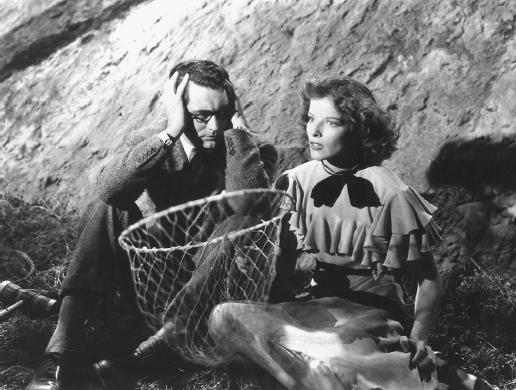
There’s something strange that the film is called Bringing Up Baby. The scenario of this untamed tiger that happens to have a penchant for “Can’t Give You Anything Love” is almost too ridiculous for words, and Susan’s initial coldness juxtaposed with her almost immediate silliness is much too strange for words. A scene as simplistic as a stone to a window turning into a stone on someone’s head are funny – if only because it is expected of us – but it’s Kate and Cary’s subsequent reactions that make it notably hilarious. And yes, even though Susan exists as a quick-witted (but yet strangely absentminded) young lady Kate is always careful not to lay it on too thick. This isn’t Tracy Lords who revels in her pedestal; Susan is simplistic enough to believe she’s behaving normally. Or she’s so caught up her games she’s convinced herself that’s it normal – either way, it’s the same thing. This measured against Cary’s almost painful reticence (in the first half hour at least) is just too obviously funny for us not be charmed, and yet Hawks doesn’t go about it being completely unsubtle.
 But it’s getting to the country house that really gets the ball rolling. Not that the film was on poor ground before, but if before was golden we now enter platinum range. Even as the film has Cary putting on women’s clothing or Kate behaving particularly crazy. We have enough of a payoff to forgive them their slight errors. Even jokes that are not particularly clever like that old stalwart's incessant attempts at imitating the beast. It becomes so rote that the humour is not the coincidence but what becomes the joke is that no one else seems to be getting either. It’s like the finale in the jail room that sometimes make me gnash my teeth and roll my eyes even as I laugh. Hawk just likes to pull our legs and yet the perversion of seeing all our characters in jail is still funny, even when it’s just wrong. It’s not called screwball for nothing. It’s exactly where Bringing Up Baby is better than many of its contemporaries. Hawks is probably going on the notion, all or nothing – and we run the full gamut of ridiculousness that’s also deliciously savoury. This happens all the while as Kate and Cary go around adlibbing, wading in pools and mistaking tigers. It happens all the while as we get taken in again and again by an old woman and her strange dog, and it’s probably the very reason that Bringing Up Baby took so long to find its appreciation in Hollywood. But who cares? It’s easily one of the decades greatest and #24 on my list of favourite films.
No, the day cannot pass without me paying proper tribute to Kate the Great...and giving you LINKS
Simon has a face-off between Kate and Chuck Norris...this could be one for the books
Nick offers up an excellent review of Kate in Summertime...I was going to write about this, but I'll let the dust settle on this before I do...intimidated much
Oooh, Katie got a stamp of her own, Ivan informs us
Anna watches Bringing Up Baby for the first time, she doesn't exactly love it...
Monday, 1 February 2010

Subscribe to:
Posts (Atom)