|
|
|---|


Thursday, 18 February 2010
I'm hosting a second episode of LAMB Casting, this time recasting Doubt. So send me an email [dangerous.liaison231 (@) yahoo.com - remove parentheses) with your choices. And if you're not a member of LAMB as yet, JOIN. 


I recently started counting down my favourite (male) performances of the last decade, so on to the females. 2005 was my least favourite year cinematically speaking of the decade, though there were a couple of performances that shone a ray of light on the darkness. Don’t forget spoilers are ahead.
#15 Rachel Weisz in The Constant Gardener (2005)


The Constant Gardener was a film that I (unlike most) was very fond of. The gardener of the title was Ralph Fiennes playing a character he knows all to well – the introverted English man. Justin Quayle. Tessa begins a tempestuous romance with Justin and travels with him to Africa. Before their journey, though Rachel already establishes Tessa as a formidable woman and as a strong character.
Her first meeting with Fiennes’ Justin is brilliant. Justin, a diplomat, is holding a meeting. He is as a calm as the clichéd Englishman and he is surprised and attracted by Tessa’s inhibition.
Sir, I've just got one question. I just wondered whose map, um, is Britain using...when it completely ignores the United Nations and decides to invade Iraq? Or do you- do you think...it's more diplomatic to bend to the will of a superpower...and-and politely take part in Vietnam, the sequel?It’s important that this is how Mereilles let us meet her since it’s a major part of her character. Tessa is one of those women we imagine only exists in the imagined world – she completely believe in the greater good and as she debates with Justin about the demerits of diplomacy it’s fascinating to see Weisz’s eyes sparkle. Moreover, it’s also interesting to note how she is so much softer during the quiet moment in between. There romance is unorthdox, but not unbelievable. Tessa’s journey grows when the two meet Africa. Tessa is a completely free spirit and even though we know that, it always surprises when Weisz burst forth with some discourteous comment on the social affairs in the country. Not even Justin is completely used to her, even though he is the perfect gentleman, throughout.

The scope of the African nation shown is formidable and Mereilles’ use of camera is important here. Moreover Weisz’s sincere chemistry with the African children is beautiful to watch. In fact a favourite moment of mine regards the relationship between them. After losing her child we see Tessa at her lowest. This is not the vigilant woman we’ve come to know and love, but a broken woman. When Justin comes to see her, she’s holding an African new born in her arms. I love her line readings – This one was born healthy, though. Weren't you, my beautiful, beautiful darling? His name is Baraka. It means blessing.


Rachel Weisz’s task in The Constant Gardener was not simple. She had to create a woman so lovable, yet so infuriating and the candid script didn’t sugar-coat it. It’s so easy to see Tessa as selfish, as annoying but Rachel manages to create a nuanced and brilliant character. Fiennes grounds the latter half of the film, but we really do miss Tessa when she leaves, and that is all because of the excellent work done by Rachel Weisz. It’s a performance worthy of remembrance.
So, were you a fan of Rachel? Or did her Oscar win make you angry?
Tuesday, 16 February 2010
It’s not regarded as a specific genre in and of itself, but it’s always interesting to note how many films tackle that “taboo” subject of growing old. Not coming age as from childhood to maturity, but the (sometimes sudden) realisation that death is imminent, dreams will not be attained and life is not what you wished it would be. It often becomes a question of our mortality. Stephen Frears Chéri is the ultimate example of being disillusioned about growing older, since the subject is that of the aging courtesan Lea de Lonval (played by a magnificent Michelle Pfeiffer). It’s a film that deserved more than it got, I for one was a fan – my review. Lea is growing older and realises that her treasures may not be as…valuable as they once were. The romance she thrusts herself into with the eponymous Chéri is pathetic, funny and poignant all at once and of course that (now notorious) final look in the camera tells more about the old enemy time than quite a few have tried in their entire duration.

The concept of age was a major theme in 17 Again, a surprisingly enjoyable comedy starring (who’d have imagined) Zac Efron. Matthew Perry’s Mike after realising the lack of mobility in his job that his golden years are long gone, and as we all do when the time comes, he yearns for the (assumed) simplicity of his youth. Of course the wrap-up is just a bit too tidy, but he learns in the process that we can never really outrun our problems, no matter how we try. It’s something I wonder if Clooney’s Ryan Bingham was considering. I really couldn’t buy into Up in the Air, the all too pithy scenarios felt much too clinical for me to believe. It’s not to say that Ryan’s epiphany is impossible, so many have probably gone through such a midlife crises but despite it’s numerous faults 17 Again spends its entirety trying to make us buy a change in Mike's temperament, so that when it comes – as tidy as it is – we are inclined to believe. On the other hand with Up in the Air, though I believe it could have happened I was not given any incentive to believe it did. A wedding does not a marriage make and as epiphanies come they are sudden but there’s always an underlying rationale or raison d’être which continues to elude me when it comes to Clonney's Ryan.

I wonder where Larry David’s Boris from Whatever Works would fit into this equation. I suppose Whatever Works is Woody slumming it, but Woody slumming is better than many “excelling”. Still, Whatever Works – as I’ve noted – is not perfect. For the most part, the troubles begin (and end) with David. He’s not the lovable old geezer that we’ve come to expect and require in Woodyland. He’s all too abrasive. But Whatever Works manages to work where Up in the Air doesn’t because Whatever Works has the sense to realise that Boris is not the beginning and end of the narrative. The supporting characters essentially hijack the third act (for the better).

The only thing our other two women Robin Wright Penn’s Pippa Lee and Meryl Streep’s Jane have in common is a daughter played to perfect irritation by the exasperating Zoe Kazan. But then, I’m being too stingy. They both are juggling two men, even if they don’t realise. I wonder what Pippa would say to Jane. Pippa’s husband like Meryl’s ex has an indiscretion with a younger woman. But Winona Ryder is nowhere as savvy (or cutthroat) like Meryl’s foil the lovely Agnes. The Private Lives of Pippa Lee did impress me more, even if it is more of a guilty pleasure type. However despite the review, the first two thirds are quite good. I realise too, that both films depend completely on their leading ladies. Both come to grips with their age, although it is harsher for Pippa considering that she’s no where as exciting as she was in her youths. They both may be juggling two men, but she’s not a bit of slut, but then neither is Jane for that matter. The real slut would have to be Lea, and that’s purely for professional reasons.

The two films which were so easily confused last year A Serious Man and A Single Man. The latter obviously trumps the former for me. Although I’m not acutely certain that either man is really dealing with midlife crises. Both men are teachers; that’s about as far as their similarities go. Larry is the epitomical good guy who bad things happen to, but so is George. Larry looks to religion and George looks to death. I’m not sure either of them finds complete fulfilment. But then again, who does?
At the end of the day Lea’s mirror gaze haunts me the most; but which battle with age leaves you must satisfied…cinematically speaking?
PS. This is the last of the 2009 in Reviews...unless there's a category I've forgotten...
I don’t have an issue with romance in films, but films that depend solely on romance are usually just a bit too bland. Even the stories that are called the greatest love stories (Casablanca, Gone With the Wind, Titanic) are not really about the romance. I wonder if Obsessed really is a romantic foray. It was not a good film, (D) obviously, strangely though the weakest of the film – Idris Elba – is the only one not up for a Razzie. I’m actually a bit surprised that Beyonce is up, not because her performance is good – but it’s really the best of all the horrid acting in the film. Obsessed just has one of the least eventful scripts of the year, and the direction is not much better. But the genre does get better as the year continues…

I gave you my reassessed thoughts on He’s Not That Into You. Still, I really didn’t appreciate the subplot of Bradley Cooper and Jennifer Connelly – she really has a knack for playing shrill and it was unfortunate that the lovely Scarlett ended up lonely, but I guess they were going for a realistic approach, which was fine for the most part. Ginnifer Goodwin just may have found her niche and she and Justin Long were charming together. I’m not quite sure of Tyler Perry’s I Can Do Bad All Myself tries to function as a romance, the film is very faulty but it’s grounded by a great performance from Taraji P. Henson, who single-handedly saves it from being drivel – a talented actress she most definitely is.
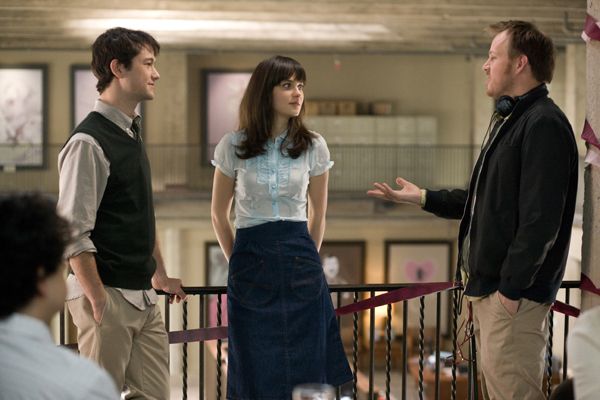
It seemed that almost everyone was bowled over by 500 Days of Summer, and I did find it to be endearing, I won’t rehash my problems with it – you can read my review – but Joseph Gordon – Levitt was obviously the star of it all. Michelle Pfeiffer’s Personal Effects (C) came and went with no noise, and it was not very inventive. Still, she managed to sell a relationship with Ashton Kutcher, which was quite tremendous. I didn’t care for Bullock or Reynolds in The Proposal; I know it made a lot of money and I like Bullock in the genre...but it really did not do much for me. And I remain uncertain as to whether or not I should call Antichrist a love story, it is a story about man and woman, and sometimes sex…but love…definitely not. Bright Star is an obvious contender here, even if I’ve already mentioned it in another category. It is quite surprising that the year was so low on romance, though that’s not necessarily a bad thing. On to 2010, we’ll see what they have for us – although the dubious beginning of Leap Year is not inviting…
Which love stories tickled your fancy last year?
Monday, 15 February 2010


I figured I could perhaps have done a review of the films of the decade, but I’m already doing one list of favourites why do another? What was intriguing me was the idea of recapping my favourite performances of the year in the male and female categories. So, forget the preamble I’m recapping my favourite males and females of the last decade. Fifteen for each: note this is my list and my list alone. You probably won’t agree, but take the journey. I should warn you – they’re spoiler filled, so don’t continue if you still wish to experience the first time thrill. So without further ado, the first on my list…
#15 James McAvoy in Atonement (2007)

I am ridiculously fond of Atonement (proof); the word fond actually doesn’t even begin to explain it. It’s the type of movie that works so well put together as it does individually and I never can decide on a favourite performance from it. Of course Robbie Turner is the only significant male of the lot so he has it easier than the others in the film. Robbie Turner is the son of a housekeeper – Grace Turner. She’s in charge of the Tallis household, Robbie is actually going to medical school because of the kindness of the Tallis, though he’s still a second class citizen. Briony introduces us to Robbie. She has just completed her play and invites him to come see it. “I don’t think that’d be appro-…” – but he doesn’t finish his sentence, though we can guess what it entails. We watch as Robbie tends to the gardener as Cecilia and Briony lie indolently on the grass. “Why don’t you talk to Robbie anymore?” Briony asks. Cee responds – “I do. We just move in different circles is all.”
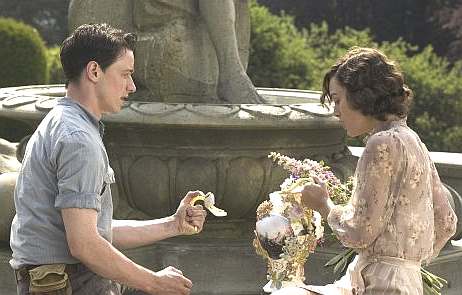
That line of Keira’s seems like a throwaway one, but it lies at the root of Atonement in more ways than one. McAvoy and Knightley have an overpowering chemistry together and they shine in each other’s presence. The breaking of the vase is one of these moments. McAvoy sells his emotions here, though his words are few. Despite the bravado of his teasing his embarrassment is palpable as he turns away from Cecilia – ever the gentleman, almost. His stuttered attempt at an apology is charming, though lost on Cecilia. It’s that moment (in addition to the heat) which leads to that licentious letter. It’s one of the more difficult scenes, though we don’t realise. We have to believe that Robbie is still the charming, innocuous young boy and still believe that he would write this letter, even if as a jest. We see him walk with the envelope as he delivers it to the wrong messenger. I love the moment where he realises the mistake and he screams…Briony. If only she’d stopped…

The next few scenes occur in a flurry, an attempted apology, a confession and then the consummation of a long realised affection, but I won’t go there. Again. The last shot of a peaceful Robbie is him coming back with the twins, it’s painful to realise that whilst he tries to help the Tallis’ they are putting the final nails in his coffin. The confused look on his face is wrenching. It’s that moment that changes Robbie Turner, and we’ll notice how James plays the Robbie, the solider, just a slight bit different from Robbie before. There’s a something hardened about him, that still sad. His slight reunion with Cecilia is poignant and it’s a strong acting moment for him and Knightley and I love how he (stupidly) tries to run after the bus as Cecilia leaves him. His tears for the schoolgirls is eerie even if we don’t decide to think of them as vestiges of the Briony that was. The scenes Dunkirk are the obvious emotional scenes (it’s a wonder so few major award bodies remembered him). His memories of his mother are heartbreaking.

Before that twist, I always wondered why he was so uninhibted when meeting Briony again (a resplendent Romola Garai), but of course it makes sense when we realise the whole. The final shot of he and Cecilia in thier imaginary ending works because of the narrative and because of the inhibition they share (in an imagind world). Atonement depends on McAvoy's brilliance. I don’t doubt that many will disagree with me on this, but I was very impressed with James McAvoy here, a true performance of the decade.
What were your thoughts on McAvoy's Robbie?
Subscribe to:
Posts (Atom)