|
|
|---|


Saturday, 24 July 2010
Today the lovely Kristin Chenoweth turns 42.
Thursday, 22 July 2010
Since it earned only two votes less than Up (which I've reviewed), I decided I'd review Nine nonetheless.
Nine, along with The Lovely Bones and Chéri from the unholy trinity of films from 2009 that I liked much more than the most.
I don’t find anything inherently dubious in the fact that I liked all three. However, my unreserved love of Nine makes me occasionally question my objectivity, the film was the one I was most excited to see last year in a way I wonder if I willed myself to like it. I’d seen 8 ½ once and my memory of it was not expansive. (like Alvodomar and Bergman, my knowledge of Fellini and other non-English directors is unfortunately sparse). I anticipated Nine because I’d had the Broadway Recording with the delectable Jane Krakowski on repeat ever since I ever found out that there was someone called Maury Yeston and read the book of the musical. From an adaptation perspective (using the musical and not Fellini’s film as the base) Nine is almost blasphemous. The bulk of the score remains (although key numbers are excised) but the screenplay bear little resemblance to the musical’s book. It is such that Nine (the film) most daringly inventive aspect is also its most exasperating.

It’s difficult to parlay my thoughts on Nine into a succinct or comprehensible review without sounding esoteric, supercilious or confused (hence this post). It’s understandable, Nine was notably panned by the majority or “important” people. Not since Le Divorce have I been so dismayed at the critical response to a film (that includes The Lovely Bones, Running with Scissors and Chéri) – incidentally that was another Kate Hudson piece with a cast to salivate over (Naomi Watts, Glenn Close, Leslie Carron, Stockhard Channing, Bebe Neuwirth). Apologies, I’ve digressed. Yes, Nine’s concept is so outlandish that it really is more abstract than realist, I’d even go as far as to approve its intentions and execution as something of an intricate piece of artwork…

Before I continue, though, I must express the slightest bit of confusion. It happened with Burton’s Alice in Wonderland and it happened with Marshall and Nine. Why are directors held accountable for the (perceived) flaws in a screenplay? With Nine the lines are admittedly more blurred. The quasi-reality of Guido’s musical consciousness becomes an enigma – one I’m not sure is the work of Marshall, Tolkin or Minghella (who’s dead and cant’ speak for himself). Perhaps, it’s some odd hybrid of all three. Though structurally Nine is only a distant relative of its stage incarnation (complete with Yeston’s approval, though) one of the things that some forget is that musical wise it’s difficult to make Lilli’s rapturous ode to French coalesce with the pseudo European pop beats of the dancing whores or the delightfully wordy and very Broadway opening number of Guido. In many ways, I expect the stage is kinder – we’d be more willing to accept the disparity in themes there. Cinema is different. Each song almost exist on different parts of the spectrum and ignoring the exception to the rule – consistency in musical forms is essential to a musical. Nine’s solution (a tentative word choice) lies blatant in the script – ten scenes in the life of a man. With the bulk of the original significance in the actual number 9 out of the film and with the eponymous number oddly absent, it’s any question that the film just wasn’t called Ten. add the eight principal vocalists together with Guido’s younger self and Dante and we’ve acquired the ten most important faces of the film. The bulk of the film occurs in the ten days leading up to the making of it, ten numbers are song: “Ten sequences, each one set in a different period”…
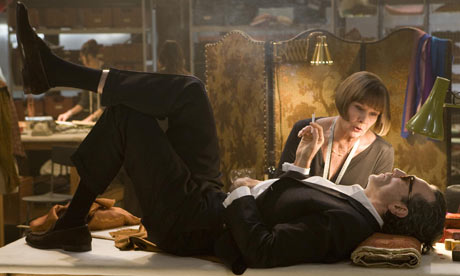
This amidst its supposed cheer (so very deliberate). Nine is not about Guido’s demise but Guido’s eventual epiphany in ten numbers. There is no thread to bind the ten episodes, but the man himself. One of the final shots of Nine is a picture of the actual film’s title card, only this time Guido is making it. Nine (the one we’re watching) is the actual Nine that Guido’s trying to create. Am I being naïve in seeing the film as a literal creation / therapy session for our protagonist? Up until the epilogue with him and Lilli precisely the sort of slightly incongruous, oddly charming, delightfully schizophrenic thing that the “new” Guido would create. Remember, all he can make now is a film about a man trying to win back his wife. Pity may not always lead to love, but it’s close enough and it’s just the sort of thing that Guido would make for Luisa.
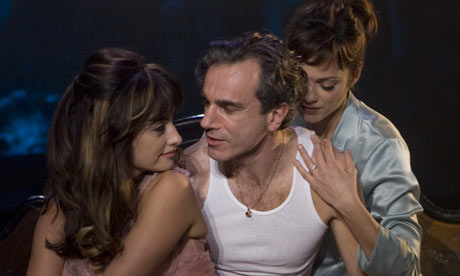
Nine is so obviously NOT rooted in reality. Marshall not-so-subtly tells us from the inception. Isn’t it odd that Stephanie – a Vogue reporter that Guido has yet to meet (chronologically at least) appears in the overture which celebrates the women in Guido’s life? The prologue acts as a beginning of our relationship with Nine but it’s all happened before – we’re now getting to see it. Measure it against the second appearance of the ensemble (sans Luisa) and the significance of the roll-call becomes more obvious.
I had a greater respect for seeing Nine this time around. Before it was just thrilling to watch and such, but I found even more method in Marshall’s ostensible madness, amidst the original fun – well as fun as a morose rumination on talent wasted can be. It is such that Daniel Day Lewis’ first impassioned (misguided) plea for world dominance is final look at the completely decadent Guido that is only hinted at. Though it’s still not my favourite actual number (look to Fergie) or my favourite song (look to Nicole); I feel great fondness for that first song. The more I see Nine (and I’ve seen it many times now) the more I come to appreciate his performance. His sensibility is precisely the type we need for Marshall’s concept. It also makes me appreciate the placing of this number as the first song in the musical – we can almost group the songs chronologically. We move from the present – Guido’s “wanting” of appreciation, his “wanting” of pleasure with Carla (which is reciprocated) and Lilli’s “wanting” of the music, the life and the laughter. Lilli yearns for fun in the moment, but she casts the narrative backward. She explicitly warns him not to do that, “That’s death.”, but he’s not known for listening. He’s looking back to Saraghina – already past. Incidentally, Luisa is looking back too, living in Guido’s past (just as Stephanie is, oddly). Guido is a bit like a hollow, albeit affable man. There is nothing to him but his movies. “My husband makes movies.” That’s it. Stephanie is not enticed by Contini, she’s enticed by Contini’s Cinema Italiano. What happens when the talent fades? Even Saraghina’s passionate urging to Be Italian doesn’t tell us much. what is it to be Italian? I don’t think Guido knows either. He isn’t helped by the fact that his mother wonders, “Do you think that so many will love you like I do?” She doesn’t answer, but she thinks no – Guido thinks so too, that’s his problem – he can’t give all of himself because there’s nothing to give.

As we head into the final trio of numbers (the three that resonate the most, despite – or because of – their bleakness) Claudia seems to be looking back but she’s moving forward really. Kidman’s “I’d rather be the man” just might be the most layered line reading of the entire film (in retrospect, her Claudia is the film’s biggest enigma). It’s this time around I notice – for the first time – the potential play on words in “Unusual Way” . Guido has made her whole by making a “hole” in her. An unusual way? Definitely – that’s why she’s moving forward without him, like Luisa. Like Guido too, actually. Guido, the man, is leaving Guido, the artist. He thinks he’s reached the epiphany – he’s wrong. The movie’s not the problem. He is. He’s such a mess of conflicting emotions that he doesn’t realise that he can make this movie – everything he needs is around him. He needs to realise that by making Nine (the movie within the movie) – a bit of catharsis, really. Notice how in that final roll call he looks not once at his supporting cast. He only has eyes for himself (well, the younger incarnation of himself). He’s not necessarily a “better” man – but he has the ability to become a more focused “artist”.

I am curious, though; does Luisa take him back when the film is complete? She’s masochistic enough, probably. The thing is, everyone wants Guido to give them more – they want all of him. What they don’t realise is that he’s giving all that he has to give. Nine came off to many as cloying, turgid, uninspired and [insert negative adjective]. I’m the opposite. For me it’s difficult to separate Nine from its protagonist. I love it for that. Am I the only one?
I don’t know about you, but this month has been particularly slow for me – I’m feeling out of it. It’s probably just me, though. Everyone else has been writing up good stuff.
It’s Emmy season and you’ll remember in my Dream Ballot I didn’t feature Mad Men too prominently. Rich Keller of TV Squad writes a great article on why he doesn’t love the show. No bashing, and I’m with him for the most part.

I'm still salivating waiting for the chance for me to see The Bening in The Kids Are All Right and Tom's review more than whets my appetite. I can't resist reading every review of this I can get my hands eyes on, so unlike me...
Because I'm similarly neurotic on occasion (i.e. always) Tim's list of inconsistencies in otherwise excellent films amuses me, especially the Beauty & the Beast one which ranks at the top of the list of egregious film errors.
I'll always have an affinity for the nineties, even though I was a babe for much of it. Luke takes a look at the Leading Ladies of the nineties (Oscar wise) - there truly were some great performances back then.
Ruben is nothing if not original and he's set up a grudge match pitting two sexagenarians - Blythe Danner and Helen Mirren - against each other. It's running until next week and he'd love to have some contributions from you.
Speaking of which, Movie Mania is interested in taking the baton up from Stinky Lulu. He's hosting a Smackdown for the Supporting Actresses of 2000.
Chris' piece is an oldie, but it's so nice to see people loving Marisa Tomei in My Cousin Vinny one of the three excellent female performances of the year that were not in Howards End (Pfeiffer's Catwoman and Sarandon in Lorenzo's Oil being the others).
I promised myself I woud not be featuring any Inception buzz (no false sentiment, and I haven't seen it) but this week old article from Nick is just too excellent not to link. I went off ranting on an entirely different tangent in the comments' section (shocker), but it raises some good points....
Remember to VOTE
Wednesday, 21 July 2010
Yesterday was Natalie Wood's birthday and I forgot to post something about it. She's often remembered and yet so underrated as an actress. Here are five excellent contributions from Ms. Wood.
Susan in Miracle on 34th Street (1947)

“I believe... I believe... It's silly, but I believe.”
Judy in Rebel without A Cause (1957)

“I love somebody. All the time I've been... I've been looking for someone to love me. And now I love somebody. And it's so easy. Why is it easy now?”
Maria in West Side Story (1961)

“Te adoro, Antone.”
Angie in Love with the Proper Stranger (1963)

“That's what love is - bells and banjos playing? How they brainwash you! And here I spend my whole life like a nut waiting for what? A stranger.”
Wilma Dean in Splendor in the Grass (1961)

“Though nothing can bring back the hour of splendor in the grass, glory in the flower, we will grieve not; rather find strength in what remains behind.”
Tuesday, 20 July 2010
Whenever it comes to Pixar I inevitably end up feeling like some curmudgeon because I don’t ever feel the usual glee that most identify with their incarnations. Finding Nemo remains as there "magnum opus", though I don't consider it flawless. Ratatouille was diverting enjoyable but not quite transcendental, WALL-E left me feeling oddly cold and Up….oh, well, Up’s a whole other story. Herein lies the review, you did ask for it.
I never tried reviewing Up. I graded it and subsequently attempted to expunge it from my mind. That proved a little difficult (what with its Best Picture nomination and what not) but I digress. An old man is on his own for the first time in a very long time when his wife of forever (it seems) dies. He experiences a case of arrested development when he vows to Journey to South America, a promise he made to his deceased wife when they were children. A cloying young boy inadvertently tags along for the ride and as Carl’s house goes up, up and away with the help of his helium balloons an adventure looms.
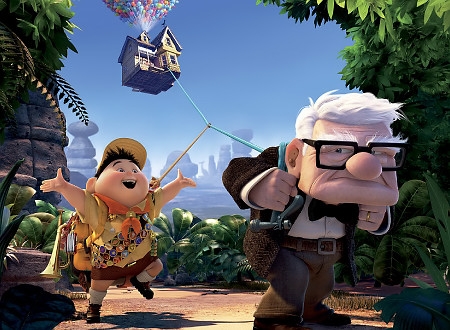
I gave Up a tentative B upon first seeing it, and re-watching it with my nephew who LOVED it I liked it less. What makes me even more dispirited is that finding the precise thing that I find off is much more difficult than I anticipated. It's exasperating. Praise was particularly effusive for the opening of Up, a ten minute short film in itself, showing us the life of Carl and Ellie. I’m not so hardhearted that I found it unmoving – the poignancy was striking. Yet, I felt a little emotionally manipulated. No one can help feeling sad at the death of a loved one, but in addition to asking us to feel for a character we’ve met for ten minutes (and learned little of, despite the emphasis on detail). However, it's not this that annoys me as much as there is nothing that occurs subsequently that is as honestly emotive. It's not that the subsequent focus on action doesn't make for a good time, but Up seems intent on having the best of both worlds; and with a battle between two worlds one eventually will prove victorious.

Ellie’s departure from the world – childless – is meant to be replaced with the arc of Russell, a somewhat annoying, and rather silly child who becomes an accidental tourist along with Carl. I hate to rag on Up by bringing up my favourite animated film of the last year, but Russell "annoyingness" seems almost on par with the similarly bothersome Wybie in Coraline. Unlike Wybie, Russell represents a significant part of the story – this is a problem. Other than a few rare instances, I don’t get overexcited by cinematic children. They’re either too annoying to be lovable or too lovable to be realistic. Russell is an animated character, but he retains the same amount of irritating talkativeness that makes me feel just a bit (just a bit guilty) for sounding like a hermit.This is the portion where I feel the urge to shout "Eureka!"

It’s on that note that I make a striking realisation. I’m more moved by the reclusive Carl of the first hour than the changed man he becomes. Perhaps my occasional misanthropic ways are showing out, but when a certain important climax of Up occurs I find myself unmoved, even a little put-out, by the message it sends. It's the "a-ha" moment where I think, "No, this is not for me." This is odd, because the message it’s sending is quite positive. For the duration of the story Carl has had an obsessive love with his house that’s almost disconcerting. Over time, though, his obsession becomes moving. Moreover, his love is understandable. This is the house he shared with his dream girl. It is just a house, perhaps, but it’s an important house of sentimental value. Thus, Carl’s impassioned declaration of “It’s just a house” after giving up all in it to save the bird and the boy doesn’t resonate with me as much as I think Docter and Peterson’s expect it to. By having Carl inevitably come to appreciate his companion and renounce his past ideals Up falls into the same trap as countless other pieces - a man changed not by desire, but a wearing down of nerves over time. And why should he have to change? The message I end up receiving is the same one that the seemingly antagonistic community were forcing down his throat from the beginning - get a life. It's a superficial thing, perhaps, but can't we allow Carl to be content alone with his house and his memories?

Moreover, the destruction of the inevitable villains falls rather flat. Each animated film must have a villain (The Other Mother, The Shadow Man etc) but though Up is more a story of a man’s growth (well, ostensibly, at least) than one of good vs evil– the de facto villain irks me. The parallels between Charles and Carl are not slight. Both men are devoted to doing things they’ve vowed after many years and it seems insensitive that in trying to show a moving portrayal of an older man Charles must be villainous because he life dream’s are in combat with our heroines. I'm hardpressed to find anything inherently villainous about him. Like Docter's judgement that Carl needs to let go, he thinks that Charles should too. Sure, he’s overly manic and his treatment of animals is questionable at best, but in deciding on the inevitable “Death to villain” end Up misses the chance for poignancy that’s too obvious to miss. Must Charles be relegated to villainous proportions because the world has forced him to prove himself?
Perhaps, in my predilection for subtext I'm overanalysing it because technically Up is a beauty. Along with Coraline and The Fantastic Mr. Fox the attention paid to character movement and set design is astonshing. I found myself entranced for a few minutes staring at Carl's hair, it was all so lifelike. Up is a perfectly competent animated film. But, I'm a glutton. I wanted better.
DISCLAIMER
Hmmmm, you did ask for me to review it – though, I know now I held off from reviewing up because I actually DON’T like raining on parades. If my bad words have left you sad, visit my blogging buddies for kinder words.
Yojimbo praises its creativity and thoughtfulness
CS offers one of the few mixed pieces, though his issues with it are not mine
Jose loves that it has tenets of so many genres all in one
Univarn appreciates it for tackling a difficult subject with charm
Mad Hatter talks about the endurance of the love connection (that sounds dirty)
Fitz loves the depth of the character and the emotive nature of it all.
Heather loves its ability to be escapism while still relishing in life’s reality.
Monday, 19 July 2010
“What is truth in art? What is truth in cinema? If by truth you look for accuracy and period detail then The Lion in Winter will not be for you. If, on the other hand, you look for that deeper truth of the Human Condition then few films get closer to identifying it. Writer James Goldman takes a warring family with 20th century feelings and responses and places it firmly into the context 12th century royal politics. It’s an extraordinary achievement aided by a superb cast (Hepburn, O’Toole, Hopkins all at the top of their game), convincingly low key design and a terrific quasi-monastic score.”
Ben, of the irreverently named Runs Like A Gay wrote the above. He’s actually been lucky enough to take part in a production of the excellent play and I couldn’t agree more with his summation. As far as history dramas go The Lion in Winter may be little more than farce, but if it’s farce – it’s irresistible farce.

“What a desolation!”
Were one to line up the reasons – rationally as possible – as to the pros and cons of Anthony Harvey’s 1968 drama, the sound question one would be moved to ask is how the film managed to be a success. The fact is, The Lion in Winter has more going against it that for it. First off, it’s a historical drama. It’s nowhere near as expansive (thematically) as A Man For All Seasons and this Henry isn’t the one that most history buffs are interested in. Secondly, in the mere few days the film covers nothing particularly pertinent happens. In fact, were we moved to ask what any particular character has accomplished during the film’s runtime we may end up answering – nothing. And conversely, while the action is sparse the film is very “talk-y”, not exactly a prerequisite for a good (or enjoyable) film about the 12th century. Yet, The Lion in Winter defies these odds. The original stage production wasn’t much to shout about (or so I heard), but perhaps it’s the inclusion of our Lady Kate, Peter O’Toole and a newly discovered Anthony Hopkins that makes it such a success. Perhaps, the story was just more suited for the film. I don’t know. Whatever it is, I always marvel at it.

It’s some time during the 12th century and Henry is on the throne. His wife, Eleanor of Aquitaine, is imprisoned in Salisbury Tower. Henry has three sons (on screen; historically there were more) and he’s uncertain whom should be his successor. There’s the lion hearted Richard, the duplicitous but sage Geoffrey and the petulant John. It’s Christmas, though, and thus the family reunites for a few days. Unfortunately, festivity is low as Prince Philip is coming to Chignon to demand that this sister be married to the heir of the throne (whomever that may be) or returned to France. Princess Alais has been in England for some time, now acting as a concubine to the King – but a marriage, to anyone, seems dubious. Thus lies the state of affairs as The Lion in Winter opens. It would be a thorny task to say what happens within the next 120 minutes, and I don’t think I’d care to explain either. Lies will be told, games will be played, knives will be drawn (as will curtains, too), persons will be duped and of course it ends with goodbyes (yet, curiously, no tears). From the inception, the atmosphere of it all is striking. Look at the earlier incarnation of Henry’s life (the 1964 Becket). This set is not the same. Unlike its predecessors the courts of this incarnation are not spotless, but soiled and unkempt – like we’d expect from the period. The Queen’s robes are majestic, but not unblemished and unlike the 1964 piece the court is pervaded by the presence of animals – domestic and otherwise. It’s not the typical period piece, and it shows.

Tom of the eclectic Reinvention: The Journal of a Dog Lover, Book Reader, Movie Goer and Writer shares his thoughts on the film.
“At the heart of this deliciously medieval drama is Katharine Hepburn as Eleanor of Aquitaine, imprisoned queen of tempestuous Henry II (the roaring Peter O'Toole). This is the consummate portrayal by one of cinema's most brilliant actresses. Hepburn demonstrates a stunning ability to speak volumes with a word, a look, a tremble of emotion. In a single scene, sometimes with a single line of dialog, she goes from beautiful and vulnerable to ironic and witty to cunning and calculating.
Director Anthony Harvey and Screenwriter James Goldman provide Hepburn with the right environment and the beautiful language for Hepburn to play at her most wonderful. The Lion in Winter is at once a mystical and haunting historical epic, domestic comedy/drama, and pageant. Harvey lights his sets and moves his camera and creates a picture unique even among historical epics. Goldman's playful script switches moods and allegiances on a dime, and often winks at us with the comparisons between this royal family and modern soap opera. (Favorite line: Oh well, what family doesn't have its ups and downs?) This film is rich in dialog and intrigue, and is worth a fortnight of viewings.
One need not be familiar with the historical origins of this story. Details are deftly filled in, so that we may enjoy the battles between king and queen and their three power-hungry sons, as well as the rich detail of the design, and the soaring and beautiful musical score.”
In the same way that the 1968 Who’s Afraid of Virginia Woolf is a tug-of-war where one cannot choose between Burton’s quiet sadism or Liz’s loud fury one should not choose between Hepburn and O’Toole (although, naturally, I do). The two are evenly matched in this battle, in words and in talent and it’s no surprise that The Lion in Winter reaches its peak in these moment. Yet, what makes The Lion in Winter stand apart of any other film with two leads is that it’s backed up by an excellent excellent cast, each intent on having his day in the sun (or at least destroying a family member). The first words on screen? …come for me. It’s too easy for me to consider it incidental, for The Lion in Winter is really all about everyone intent on outmanoeuvring their peers. I’ll get it out of the way now, Jane Merrow’s Alais presents the film’s only clunker, the less said about her – the better. It’s more than her obvious inadequacy when measured against our Lady Kate but her foppishness makes the film just a little sluggish when she takes centre stage. But she’s surrounded by masters (or at least novices doing a good job of pretending – and isn’t that the same?), so it doesn’t hurt us much. I continue to marvel at the wondrous thing that was John Castle’s performance at the middle – Geoffrey. I still remain confused as to why this performance is so forgotten, and even more flummoxed as to Castle’s inability to make a large mark on film hereafter. Nigel Terry and a young Anthony Hopkins round out the trinity, with Hopkins being particularly moving opposite his Ms. Hepburn. His steely elegance reminds me of Russell Crow circa Gladiator.
Yojimbo, of Let’s Not Talk About Movies opines:
“This is red meat material, chewy and sinewy and full of juice and played by a cast of gourmands who relish the consuming—even Katherine Hepburn, who knew the value of stillness, knew when to tuck in and tear away at a juicy part. The cast, including a debuting Timothy Dalton whose entrance always evokes a smile (with his first ebullient shot not only does he show he deserves to play a King, but also play against Peter O’Toole!) makes the most of rich, if maybe a shade too contemporary, material by James Goldman-his personal best. That the film is so rich is due to the delicious script, and actors, as the other films of director Anthony Harvey are relatively bloodless. It’s an event film, with both Peter O’Toole and Hepburn at the top of their roaring games, and Anthony Hopkins, young bull that he was, giving a glimpse of the glowering powers he would bring to the screen.”
Like him, I too appreciate the script as one of the film’s highlight. If I had to single out a script as the best of all time – I’d single out The Lion in Winter in a heartbeat. The lines roll off the tongue like syrup, anachronistic at times but striking nonetheless. As we continue on the journey through the top ten we reach films where the faults are less and less, and ultimately I forgive Jane Merrow’s poor showing in the film because she sells her final pieces with O’Toole so sincerely I wonder if it took time for her to find her talent (or perhaps convection of talent from O’Toole and Hepburn),. But then, when I remember I return to the man and his wife. O’Toole and Hepburn give my two favourite performances of the decade and the film is a masterpiece. When it ends he turns to his queen and says “I hope we never die.” She answers without sentiment, “So do I.” With these performances I warrant that they won’t. It falls at #6 on my list of favourites.
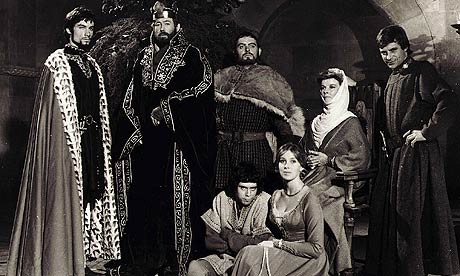
What are your thoughts on Kate and Peter here? Are you a fan of the script? ...of the movie?
Music Break [...With Gene Kelly, Donald O'Conner & Debbie Reynolds]
0 comments Posted by 2011 at 06:03The song essentially says it all. Enjoy.
Subscribe to:
Posts (Atom)