Tuesday, 4 May 2010

...that's all...

…and I’m not talking about The Nightmare Before Christmas, which he didn’t even direct. I’ve said it before, I’m a fan of Burton even though I don’t love his work wholly. He’s no Scorsese – but, few are. The man has issues, but I think credit should be given where it’s due. It’s ironic somehow that my two favourite Burton pieces are two that I rarely hear people championing. I admitted my love for Big Fish before, and the 2005 magnum opus (I kid you not) that was Corpse Bride appears in my list of favourite films. It holds the distinction of being my favourite animated film. It’s probably not incidental that Corpse Bride features Helena Bonham Carter and Johnny Depp – mainstays of Burton’s filmography. The film introduces us to a young man, something of a simpleton, set to be married. Whilst practising his vows in the forest he mistakenly gives the eponymous Corpse Bride the impression that she is the object of his desire – and thus, the drama ensues.
When we think of things that are Burton-esque thoughts of dark, somewhat macabre humour are evoked. We recall dark and gloomy sets with nary a piece of light, and of course we imagine a fascination with death and such things. Corpse Bride serves up all, and I suppose it’s easy to mistake it for Burton’s lack of wit or unoriginality. Perhaps, but each time I watch this film I’m constantly amazed at the complexity and sensitivity that Burton manages to infuse in an eighty minute animated tale. The atmospheric nature of it probably means that children will be diverted by the look of it, but Corpse Bride is not about the aesthetic – at least, not alone. Helena Bonham Carter is someone I’m very fond of, and her incarnation of the Corpse Bride is the strongest work she’s done alongside Burton – but for the whole animation glitch. There’s something profoundly real about the deliberate self-delusions she yields to and it’s precisely why the film is named after her, even if it takes some time for us to actually meet her. Her poignant departure from the film always moves me, even if it’s just a little too pat.
Speaking of that “pat” ending, I’m well aware that Corpse Bride is not without its glitches – but I suppose the fact that I like it despite them (or maybe because of them) that makes it a favourite of mine. It’s maddeningly short, so that just as you’re about to experience the first swallow of contentment it’s all over. And of course, because it’s animated, there’s the rare penchant to infuse it with some inane form of physical comedy, but Corpse Bride triumphs nonetheless. As someone who’s openly (but not on the blog) disliked Wallace & Grommit I consider it a great disservice to animation and Tim Burton that Corpse Bride lost that Oscar 2005. But, then again, isn’t that the usual? The decade ends and with its apparent sleight of hand in animation everyone remembers Pixar only and the odd Shrek or Fantastic Mr. Fox. When Coraline **came out least year (#3 of 2009) I championed it for its atmospheric similarities to Corpse Bride. Coraline didn’t win the Oscar either, so I guess Corpse Bride isn’t bad company…but it’s unfortunate that it’s rarely remembered when we stop to talk about the aughts and how it changed animation for the better. Corpse Bride is a proud entry in my list of favourite films at #32. Hopefully, I’m not the only one who remembers it with such fondness.

Monday, 3 May 2010

Chloe

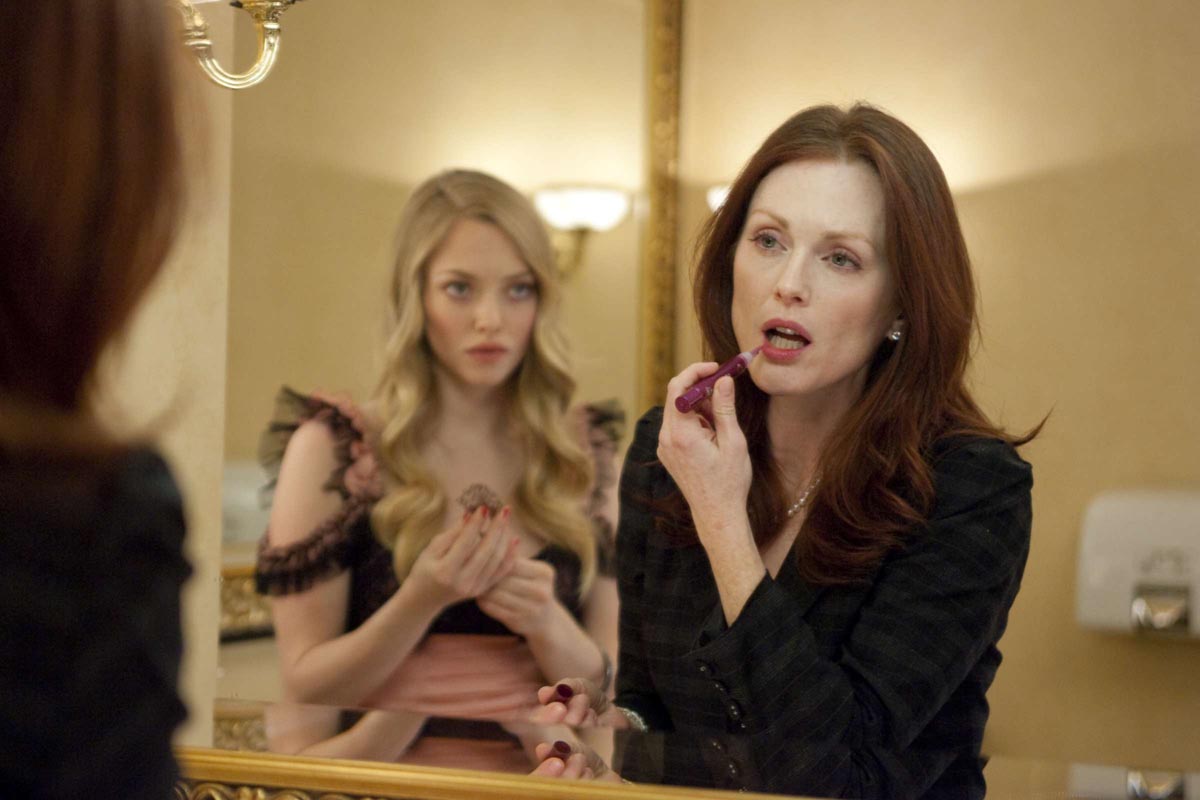
When Chloe opens with those shots of Amanda Seyfried as she ensues in her monologue of sorts, Atom Egoyan gives us the impression that what follows will be an exposé (of sorts) on this woman and her life. Chloe is not such a film, I can’t pretend that any apprehensions I have about the film derive from the opening, but in assessing why Chloe left me somewhat cold I couldn’t help but revert to the beginning which had me anticipating something completely different from what ensues. In fact, at the end the first thing I wondered was – How did the beginning enhance the film?
Despite its name, Chloe is the study of a marriage. Catherine and David, played credibly by Julianne Moore and Liam Neeson are a marriage couple. She’s getting old and worried about her age, he’s getting old and more flirtatious (but still chaste, we can assume). A provocative image on his phone when he misses a party leads Catherine to hire the eponymous Chloe to seduce her husband and report the results. It’s a fairly simple story, a pedestrian one even. This can only end one way for us to have a movie – he sleeps with her and tragedy ensues (I’m well aware of the deception in this statement). In this way Chloe depends on a twist that’s not really a twist, but my issue is not even with the twist. Egoyar crafts a film that’s beautifully shot, the writing is fair even though it’s unexceptional and it’s not so much that the denouement of it falls flat, but the viewer is left with the question – so what? This is, essentially, my issue with Chloe. I’ve never seen the original, and cannot comment on if Chloe is a misrepresentation of it. I remember chuckling to myself when I heard the name of the director, how could I take such a name seriously? It’s the same issue I have with Chloe. At face value it’s the study of a marriage that ultimately is saved, but with cracks in it (that final shot of Julianne). Nothing more, nothing less. But the story is one devoid of any individuality, and the very title (and that telling opening) has me rethinking it.
SPOILERS: Be warned!!!
The film opens as we watch Seyfried in moments of undress as she narrates over the film. It’s a poor opening, I think, in context at least. It’s significant that this is the only narration in the film, opening or otherwise. What’s more, Chloe is obviously not the main character of the film, so why begin with her in a state of pseudo-omniscient. Is the opening even chronologically related to the film? A crazy thought occurs to me, is Chloe even dead? Obviously she is; the maimed body alone is proof. But Chloe being alive is the only way that the film’s beginning makes sense. And since it’s obvious that she is dead Egoyan’s Chloe falls flat. Or if not, I was waiting for a moment of absolution when we’d realise that Liam’s David was just the consummate actor and did have an affair with Chloe. But alas, no such twist. It’s fine to look at and completely diverting but as I gain a little distance I also gain some perspective. It’s been a full week now and Chloe’s significance seems stark. Technically, it’s adequate but Egoyan seems to have no argument to put forward behind the pretty shots…or if he does, it completely eludes me.
        
C+

The cultural significance of Titanic are colossal and difficult to miss. Its fourteen Oscar nominations and eleven wins are unsurpassed. Up until Avatar it was the cinema’s biggest money maker. It marked a deep reworking of technology in films. It reworked and essentially launched the careers of Oscar nominees at the time Kate Winslet and Leonardo DiCaprio to super stardom and it spawned a number of spoofs about jewels in the water. It subsequently became one of the most, if not the most reviled Best Picture winner that few were willing to express affinity for. Luckily, I’m not a proud person because I feel no sense of embarrassment in citing Titanic as on of my favourite films.
Titanic is not my favourite film, but I marvel at the sheer scope of the piece. The film spans over three hours and yet persons who’d bemoan the cumbersome nature of other excellent pieces (like The English Patient, Gosford Park even The Lord of the Rings) would be willing to take an uninterrupted gander at it. Call it what you will, but few films of such length can keep the audiences interested for so long. As a narrative Titanic is split, evenly more or less, into two parts – the romantic half (pre-iceberg) and the action half (post-iceberg). Of course, like any film with a split narrative there are moments where the two overlap, and both “parts” are mediated by the words of our narrator in question Gloria Stuart. If forced, I’d probably single out the first half as my favourite even though each has things going for it. It’s the in the first part where the ensemble nature of Titanic is most evident. I’ll admit, Cameron is no E. M. Forster with his writing but I’m always wary of his critics who seem to officious. I’m not sure if it’s his skill for the inane, or the actors skill for the camp but it all works gloriously – like Fisher’s bedroom confession to her daughter, “Do you want to see me working as a seamstress?”; or Winslet’s much-too-verbose Rose’s soliloquies of sorts “Look, I know what you must be thinking! Poor little rich girl. What does she know about misery?”. The words are not the beacon of the film, but there’s some sort of sadistic thrill as I watch hearing Billy Zane tear through lines like, “Yes, you are, and my wife. My wife in practice if not yet by law, so you will honor me. You will honor me the way a wife is required to honor a husband. Because I will not be made a fool, Rose."
The thing is, even though it’s the first half that sets Kate and Leo up as dramatic actors it’s the second half that solidifies their skill. Certainly, they’re nowhere near the top of their game but the work they do as the ship begins to sink should not be ignored. It’s the difficulty that countless actors today cannot overcome. Winslet and DiCaprio need to effectively act against the already overwhelming backdrop of the special effects and they emerge doing credibly good jobs. The sinking of the ship is a thoroughly amazing visual spectacle, and yet we rarely forget the ill-fated lovers, for each actor carves a true character against the almost impossible. For Winslet it’s the film’s most deliciously ridiculous moment – as Rose is lowered into the lifeboats only to subsequently jump off, Kate has no lines and it’s up to her to sell a plot device that’s borders on fanatical; and she does. It’s an indicator of the brilliant actress to come. For Leo it’s later, and shorter. The moments just before his “death” are poignant, even if in its deliberateness. “you're going to make babies and watch them grow and you're going to die an old lady, warm in your bed."
          
Of course, the crux of my argument for the film should lie in its consummate technicalities, but I won’t bother. The costumes, the art direction, the visual effects and even Horner’s score which manages to remain poignant despite the recitative nature. What makes a film good? I don’t know, but I do know I’m willing to sit down and look at Cameron’s film whenever it’s on. I know the narrative like the back of my hand, I can recite the “inane” lines as if I wrote them and when anyone is moved to lambast it for its faults I’m often moved to imitate Rose and Jack; when the infuriating footman tries to warn them about the folly of their ways the turn around to him in unison and say “Shut Up!”
       
Titanic appears at #23 on my list of favourites.

Sunday, 2 May 2010

Open Thread

Sorry for the lack of Scene On A Sunday today, but I'm currently navigating without the use of a mouse and it's just too tedious doing all that mumbo-jumbo with a keyboard. I just recently Bright Star, I know it wasn't loved by all, but I'm loving it even more as time goes by...


What's on your mind? Seen any thing good lately

Saturday, 1 May 2010

In the RKO dressing hairdressing department, during the spring of 1939. I eavesdropped, over a half a wall, on a 6 A. M., over-coffee conversation, involving Lucille Ball, Barbra Stanwyck, Ginger Rogers and several unidentifiable voices. Lucille and Ginger were making Stage Door with Kate at the time. Barbara Stanwyck was on The Mad Miss Manton.

There was general studio agreement that Katharine Hepburn was a dazzling actress and a star, but there was some question as to whether she was going to become box office.


The voices said:
“She’s gorgeous. How can she miss?
“Takes more than gorgeous, sugar.”
“Yeah? Like what?”
“Talent.”
“Luck.”
“Hits.”
“That’s it. Hits. Listen to her her.”
“So. She’s had hits.”
“Not lately.”
“What do you call ‘lately’?”
“What about Alice Adams?”
“Two years ago.”
“All right.”
“All right if she’d done nothing since, but she’s had strike-outs in the two years. Sylvia Scarlett.”
“Help!”
“Break of Hearts.”
“I liked it.”
“But Kokomo didn’t.”
“Mary of Scotland. Wasn’t that a hit?”
“No.”
“Yes.”
“No!”
“No.”
“A Woman Rebels.”
“She should’ve, before she said yes to that turkey.”
“Quality Street?”
“They say she picked that one herself. Well, whoever. The people didn’t want it.”
“She’s gonna score in this one, though. Boy, is she ever great.”
“Yeah, but we’re talking about star. The ones people come to see, no matter what. Gable, Tracy, Harlow, Bette. Like that.”
“Maybe Hepburn’s too special.”
“What do you mean?”
“Too, like – well, like high-toned. Not like us.”
“I’m high-toned you pisspot!”
The unmistakable voice cut-through voice of Lucille Ball took over.”

“Listen biddies, don’t you worry your pretty little heads – and I do mean little – about Miss Katie. She’ll make it just fine. She knows the combination to the safe. To everybody’s safe. Have you ever noticed something? How every time she gets into a new scene, no matter where, or on the stage, and she’s wearing a new outfit, every son-of-a-bitch on this lot, from every department, finds his way over there – or her way – to stand around and gawk? Why is that? Don’t ask me, but they sure all want to look at her, and see what she doe. I do it myself. And the grips from the other sets and cutters and messengers and readers. The all find their way and stand around taking her in like out-of-town visitors. I notice they don’t do it for any of the rest of us. Only for her. So why is that? Don’t ask me. But I claim anybody who can get a routine like that going for them, without trying even, has to become a big star, and, what’s more, stay a big star. She’s news, that’s all. Hot news. All the time.”

The instinctively sagacious Lucille, who wound up owing that very studio, had recognized (sic) it. Call it news, hot news, call it “it,” as Eleanor Glyn did for Clara Bow, or call it, as we do these days, charisma. Katharine Hepburn had it and has it.

Kanin, Garson. Tracy and Hepburn: An Intimate Memoir. New York: Viking Press Inc, 1971

Green Zone

Matt Damon has a knack for being unassuming. It’s a talent that has been put to good use in The Talented Mr. Ripley and Ocean’s Eleven. I’m never certain if Matt Damon, the actor, is just as unassuming or if he’s just that good of an actor. In Green Zone he plays Captain Miller, an American soldier intent on finding answers in Iraq circa 2003. Damon’s Captain is cool but not pushy. As he marches through the film I am aware that I’m watching Matt Damon, but I’m also willing to believe that I’m watching the actions of a real soldier. Paradoxical? Naturally. Maybe I started this review on the wrong foot, for Green Zone is a film that depends on factors that are not all Matt Damon.
I remember someone referring to Green Zone as a film from the “shaky cam” genre (a la The Hurt Locker or A Mighty Heart). The thing is, though, as accurate a definition as that would be, it marginalises the film. Green Zone, is not a film for the unfocused. Helgeland’s script is uninterested in spelling anything out to the audience and if you don’t know the story he doesn’t condescend to spoon feed it to you. It’s not that the narrative is particularly difficult to follow; but if you’re not willing to pay keen attention you could easily miss some important details. Then, there’s the fact that it all occurs amidst an overwhelmingly authentic sound design. If The Hurt Locker could have swept the sound categories (undeservedly, I might add) Green Zone should be a shoo-in for a nod, but of course that’s not likely.

Admittedly, the film is anchored by Damon’s performance, even though I’m well aware that the term anchored may be an overstatement. Damon’s performance is good, effective even. But Greengrass is not interested in turning this into the story of a David against the Goliath’s of the world (even if the poster suggests otherwise). Damon is obviously the lead of the film, but the supporting cast are important. Greg Kinnear avoids the stock characterisation his role could have implied, and in the process he creates a moderately impressive villain. Brendan Gleeson is similarly good and Eastern actor Khallid Abdalla lends the right amount of pathos to his conflicted character. I will admit, the purported presence of the lovely Amy Ryan was a major reason I was interested in seeing this film. As it turns out (I should have expected) her role is not big, but like her short turns in Before the Devil Knows You’re Dead and Changeling she carves a realistic being with just a few scenes to her name.
The unfortunate reality is, though, owing to the almost journalistic nature of Green Zone it has a tendency to come as decidedly ephemeral. As well intentioned as it is, there is a certain lack of profundity that pervades. As good an effort as it is I don’t think I’d be moved to see it again. But I think it’s worthy of being seen at least once…provided you go with your brain. 
          
B

Related Posts Plugin for WordPress, Blogger...
 

FREE HOT VIDEO | HOT GIRL GALERRY